
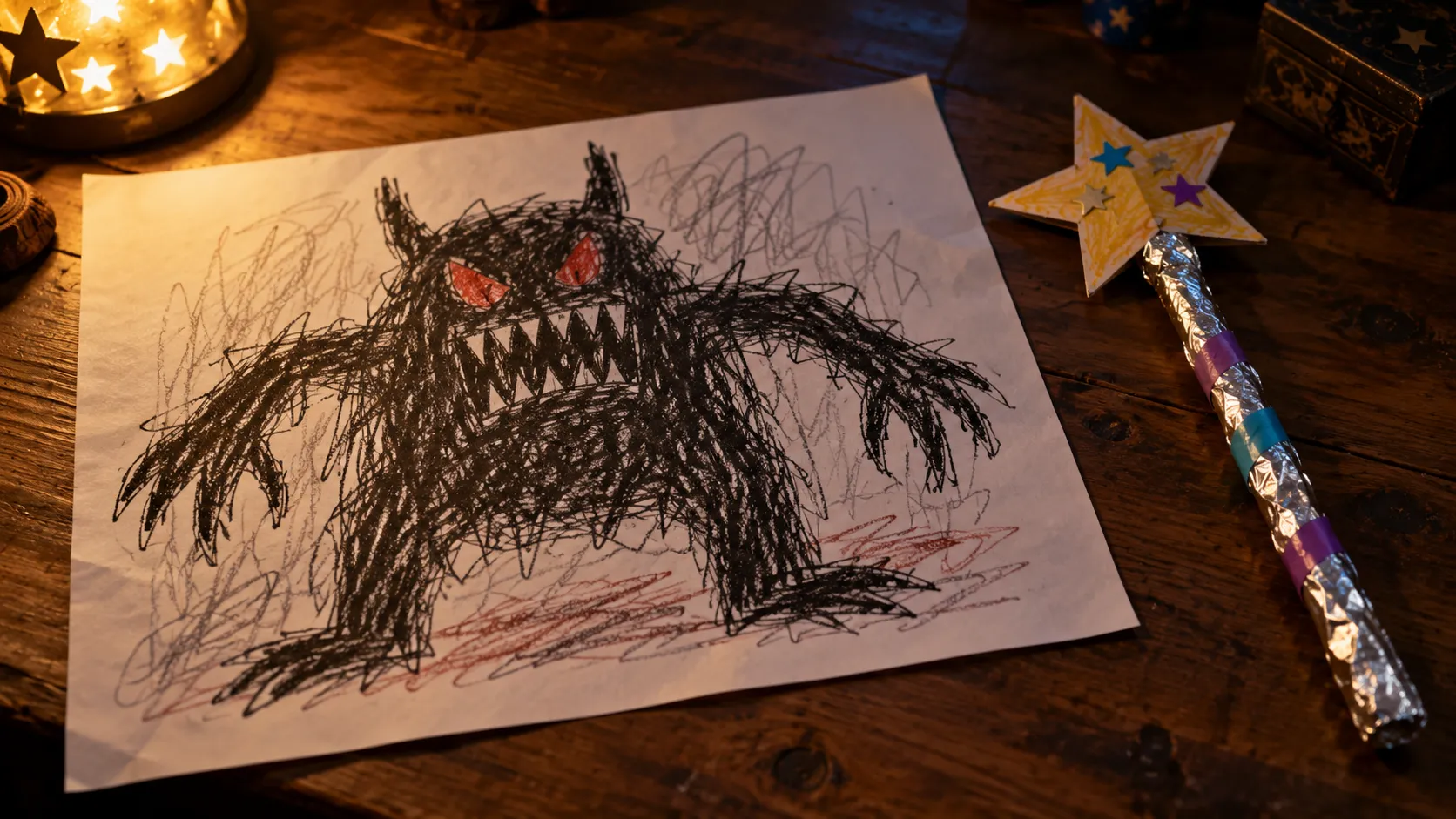
Tommy was eight years old, and every night something came for him. A monster held him frozen in his bed, too terrified to move. He couldn’t sleep. He couldn’t eat. He’d stopped going to school. Talk therapy hadn’t helped, so his parents took him to a psychiatrist. The diagnosis was early childhood schizophrenia. The recommendation was a hospital stay and antipsychotic medication, and the family was ready to accept both.
Before they did, a trainee therapist named Mary made them an offer. She was part of a training group run by family therapist JoAnn Depetro, and she asked whether they’d come to just one session with the team for another opinion. They agreed.
The session took place in a room with a one-way mirror. Depetro and her team of trainees watched from the other side, while Mary sat with Tommy and his mother. Depetro could speak into Mary’s ear, feeding her what to say.
As his mother described the problem, Tommy crawled into a corner of the room, hiding where the team couldn’t see him.
Drawing the monster
Depetro’s first move was simple. Through Mary, she told Tommy it sounded like a truly terrifying monster, and asked whether he’d draw it so the team could understand how frightening it was.
Tommy came out of the corner. He took the paper and drew the monster with fierce concentration.
Then Mary made the mistake almost any kind adult would make. She looked at the drawing and reassured him that it wasn’t so scary.
Depetro stepped straight in, speaking to Tommy through the mirror: “We the team are back here shaking and frightened.” The team said how awful the creature was, and that it was no wonder he was so afraid.
Tommy looked surprised, then pleased. He agreed with them. For the first time, the grown-ups were taking his monster seriously. Mary apologised to him for not understanding his fear, and he became more and more involved in the conversation.
A special gift
Then came the turn nobody expected, least of all Tommy. Mary told him that he must have a special gift to be able to see such a terrifying monster, and asked whether he thought he had a special ability.
Tommy lit up. Yes, he did.
His mother started to cry. She hadn’t seen her son so energised in a long time.
The team talked with Tommy about how hard it must be to have an ability like that, and whether it took a special kind of imagination to see such things. Then they asked the question the whole session had been building towards: if he had a gift strong enough to see the monster, might he also have the power to destroy it and make it disappear?
Tommy thought he might. He also wanted the team’s help.
The wand and the team
Every monster-slayer needs equipment. The team suggested a magic wand, and Tommy liked the idea. They suggested he’d also need a team of his own, people he trusted, for such a brave job. Tommy named four. The therapists suggested that this team could help him make a wand strong enough for the task, and that he should keep it beside his bed at night, because the work would take courage.
They asked Tommy and his mother to come back in a month. And they asked Tommy to bring the wand, so they could see it and use the idea to help other children defeat their monsters.
The Monster Slayer
The following week, Mary reported that Tommy’s mother had cancelled the hospital stay and the medication.
A month later, Tommy walked back into the clinic beaming, carrying a magnificent monster-destroying wand. The team had a surprise ready: a badge announcing his achievement. Mary pinned it on his shirt. It read Tommy, the Monster Slayer.
He told them how he’d done it. It hadn’t been easy, he said, but he’d kept using his special ability, and he’d won. He was eating again. He was back at school, wearing his badge. When Depetro followed up later, Mary reported that Tommy was still proud of himself and living a full life.
It’s a wonderful story. It also raises questions researchers have spent decades on. Was Tommy really ill? And why would a wand work when a psychiatrist had recommended hospital?
Most children have monsters
The first surprise is how ordinary Tommy’s fear was, at least in kind.
In a 2001 study, Dutch psychologist Peter Muris and his colleagues asked children aged four to twelve about fears at night. Nearly three-quarters reported them. The most common were exactly what you’d expect: intruders, imaginary creatures, frightening dreams, things in the dark. As children’s imaginations grow, so does their ability to imagine something worth being afraid of.
What set Tommy apart was severity. His fear had stopped him sleeping, eating and going to school, and that’s what led to the frightening diagnosis.
Seeing things isn’t always what it seems
Schizophrenia beginning in early childhood is extremely rare. Hallucination-like experiences in young children are not.
In a large Dutch study published in 2010, Agna Bartels-Velthuis and her colleagues surveyed thousands of seven- and eight-year-olds and found that about one in eleven reported hearing voices. For most, the experiences faded over the following years, and the great majority never developed a psychotic illness.
Children’s imaginations are vivid, and at eight the line between “I imagined it” and “I saw it” is blurrier than at thirty. That doesn’t make a frightened child’s experience any less real or less distressing. But it does mean a label can sometimes run ahead of what’s really going on.
The problem is the problem
Tommy’s therapists weren’t improvising. JoAnn Depetro trained therapists in narrative and social constructivist approaches, and what happened in that room was narrative therapy at its most vivid.
Narrative therapy was developed in the 1980s by Adelaide family therapist Michael White and his New Zealand colleague David Epston. White had noticed that when children were frightened, adults tended either to argue with the fear (“there’s no such thing as monsters”) or to treat the child as the problem. Neither worked well. Instead, he helped children treat a fear as something separate from themselves, a creature with habits that could be studied, outwitted and defeated. He called his work with young children’s fears “monster taming”.
The central idea of narrative therapy is often summed up in one line: the person is not the problem; the problem is the problem.
Look at what Depetro’s team did. They didn’t tell Tommy the monster wasn’t real. They gave it an outline on paper, which put it outside him. They recast Tommy, not as a sick boy with a diagnosis, but as someone with a rare gift. And they gave him a new story about himself, then made that story official with a badge.
Even the one-way mirror belongs to this tradition. The “reflecting team”, a group of therapists who observe a session and then share their thoughts openly with the family, was pioneered in the mid-1980s by Norwegian psychiatrist Tom Andersen. It’s a way of letting families hear many voices, and many possible stories, about their problem. In Tommy’s case, it meant a whole room of adults could be frightened alongside him, and then believe in him.
Recruiting the hero
There’s an older thread too. In 1962, South African psychologists Arnold Lazarus and Arnold Abramovitz described a technique they called emotive imagery. Instead of trying to calm frightened children down, they invited them into exciting stories where their favourite heroes stood beside them while they faced what they feared. The excitement and confidence of the story seemed to crowd out the fear.
Decades later, researchers in Queensland, including clinical psychologist Susan Spence, tested emotive imagery with children who were afraid of the dark. The children who received it became far more able to tolerate darkness than children on a waiting list.
Milton Erickson called the same principle utilisation: instead of fighting what a person brings, you use it. Tommy brought a monster. His team gave him a wand.
Why it worked
Put the story and the research together, and each step makes sense:
- Drawing the monster gave a formless terror a shape, and a shape is something you can deal with.
- Being frightened with him told Tommy his experience was being taken seriously. Mary’s apology mattered too, because it showed that even the adults could get it wrong and change their minds.
- “A special gift” turned him from a patient into a hero, the reverse of what the diagnosis had done.
- His own team of trusted people meant he didn’t face the monster alone.
- The wand by the bed gave him something to do at the exact moment fear struck: at night, alone, in the dark.
- The badge made his new story public. Everyone at school could see who he was now.
None of it needed a formal trance. But it was built from the same materials as hypnosis: expectation, imagination and the power of a well-chosen story. Commenting on the case in the Erickson Foundation newsletter, psychologist Eric Greenleaf noted how mobilising the boy’s imagination succeeded where hospitalisation and medication had been recommended, with almost none of the side effects.
A note for parents
Most children’s night fears pass with time, reassurance and a little imagination of the kind Tommy’s team used. But if a child’s fears are severe or persistent, or are stopping them sleeping, eating or going to school, get a proper assessment from a GP or a child mental health professional. Tommy’s story isn’t a reason to avoid professional help. It’s a reminder that the best help often starts by taking a child’s experience seriously, rather than dismissing it or rushing to the most frightening label.
Further reading
- Depetro J. “A Special Imagination.” Case Report, with commentary by Eric Greenleaf. The Milton H. Erickson Foundation Newsletter. Vol. 45, No. 1 (April 2025), p. 10. https://www.erickson-foundation.org/s/EricksonNews-45-1-WebFinal.pdf
- Muris P, Merckelbach H, Ollendick TH, King NJ, Bogie N. “Children’s nighttime fears: parent–child ratings of frequency, content, origins, coping behaviors and severity.” Behaviour Research and Therapy. 2001;39(1):13–28.
- Bartels-Velthuis AA, Jenner JA, van de Willige G, van Os J, Wiersma D. “Prevalence and correlates of auditory vocal hallucinations in middle childhood.” British Journal of Psychiatry. 2010;196(1):41–46.
- White M. “Fear busting and monster taming: an approach to the fears of young children.” Dulwich Centre Review. 1985. Reprinted in White M, Selected Papers, Dulwich Centre Publications, 1989.
- White M, Epston D. Narrative Means to Therapeutic Ends. Norton, 1990.
- Andersen T. “The reflecting team: dialogue and meta-dialogue in clinical work.” Family Process. 1987;26(4):415–428.
- Lazarus AA, Abramovitz A. “The use of ‘emotive imagery’ in the treatment of children’s phobias.” Journal of Mental Science. 1962;108:191–195.
- Cornwall E, Spence SH, Schotte D. “The effectiveness of emotive imagery in the treatment of darkness phobia in children.” Behaviour Change. 1996;13(4):223–229.