

“Don’t touch me!”
In May 1889, a wealthy widow arrived in Vienna to see a young neurologist who was not yet famous. Her name was Fanny Moser. Born a Swiss baroness, she had married a much older industrialist, and after his death she had become one of the richest women in Europe.
She was also deeply troubled. Every couple of minutes, her face would twist into an expression of disgust, and she would make a gesture as if pushing away an invisible attacker: “Don’t move! Don’t say anything! Don’t touch me!”
The neurologist was Sigmund Freud. When he wrote up her case six years later, he disguised her as “Frau Emmy von N.” In 1889 his main tool was hypnosis. He would put her into a trance and question her about where her symptoms came from. Under hypnosis, she recalled terrifying memories, among them that when she was five, her brothers and sisters had often thrown dead animals at her.
Then, one day, Fanny Moser lost patience with her doctor. As Freud later recorded, she told him, in a distinctly grumbling tone, that he was “not to keep on asking her where this and that came from”, but to let her tell him what she had to say.
Freud listened. His English editor, James Strachey, later suggested this may have been the earliest appearance of what became Freud’s most famous technique: free association, simply letting the patient talk.
The founder of psychoanalysis learned one of its cornerstones from a patient who wanted him to be quiet.
The young hypnotist
Freud didn’t set out to invent psychoanalysis. In the 1880s, he was a young Viennese doctor drawn, like many of his generation, to the most exciting and controversial treatment of the day: hypnosis.
He studied in Paris under the great neurologist Jean-Martin Charcot, whose dramatic hypnosis demonstrations drew crowds. Freud kept a print of the famous painting of one of them for the rest of his life. (We tell that story in Famous Hypnosis Experiments and What They Found.)
He also travelled to Nancy, to learn from Hippolyte Bernheim, Charcot’s great rival, who argued that hypnosis was simply heightened suggestibility. Freud translated Bernheim’s book into German.
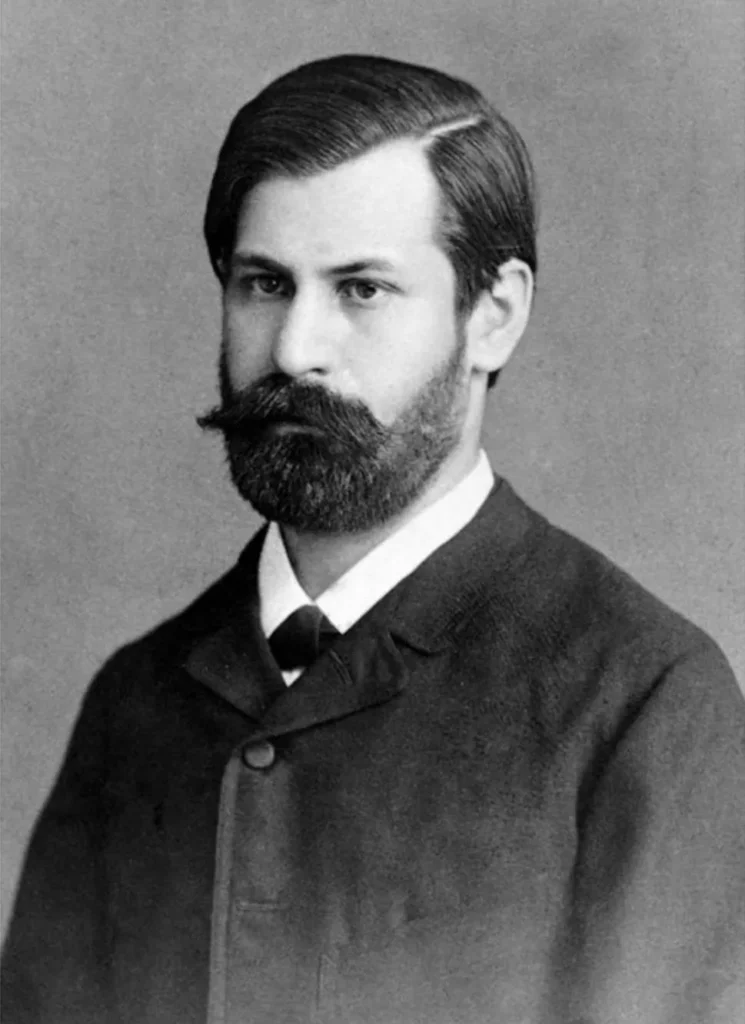

He had learned from both sides of the great debate in the history of hypnosis, a field that had only gained its name decades earlier, when the Scottish surgeon James Braid coined the word “hypnotism”. But Freud’s most important influence was closer to home: his older friend and colleague Josef Breuer, and one extraordinary patient.
Anna O. and the talking cure
In 1880, a brilliant, intensely imaginative young woman named Bertha Pappenheim fell seriously ill while nursing her dying father. She developed a bewildering range of symptoms: paralysis, disturbances of vision and speech, and long periods in which she could only speak English, though she still understood the German around her.
Breuer treated her almost daily. He noticed something remarkable. In her trance-like states, telling stories and talking through what was troubling her brought relief.
The process was her own idea. She called it the “talking cure” when she was being serious, and “chimney sweeping” when she was being playful.
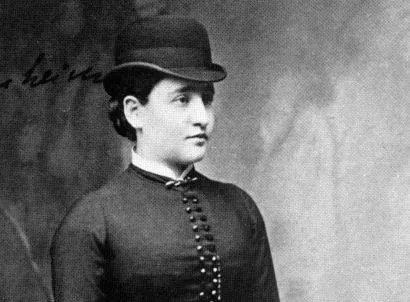

The most famous episode involved water. For weeks, Pappenheim couldn’t bring herself to drink, however thirsty she was. Then, under hypnosis, Breuer led her back to a memory: seeing a dog drinking out of a glass. Once she had told the story, she was able to drink.
When Breuer and Freud published the case in their Studies on Hysteria in 1895, they gave her a pseudonym: “Anna O.”, made by shifting her real initials, B.P., one letter back in the alphabet. In 1909, Freud credited Anna O. and Breuer with discovering that recalling past incidents could relieve symptoms.
It became the founding story of psychotherapy. But, as we’ll see, it wasn’t the whole story.
A hand on the forehead
Freud soon ran into a problem: he wasn’t a very good hypnotist. Not every patient could be hypnotised, and some of his could not be hypnotised at all. Freud was determined to reach their forgotten memories anyway.
He remembered an experiment he had often watched Bernheim perform. People who had been hypnotised could, with enough encouragement, recall what had happened in trance after they woke. If that was true, Freud reasoned, his patients must somehow “know” everything that hypnosis had revealed. With his assurance and encouragement, perhaps helped by the touch of his hand, the forgotten memories might be pushed back into awareness.
So he tried exactly that. In Studies on Hysteria, he describes an English governess, “Miss Lucy R.”, who was haunted by a smell of burnt pudding, and who couldn’t be hypnotised. Freud pressed his hand on her forehead and told her that a memory or image would come to her when he released the pressure. It was a strange halfway house: no longer hypnosis, but not yet psychoanalysis either.
The embrace
Then something happened that changed Freud’s mind about hypnosis altogether.
He described it decades later, in his Autobiographical Study of 1925. He had been treating a patient with excellent results. One day, as she woke from a trance, she threw her arms around his neck.
Freud wrote that in that moment he grasped the mysterious element at work behind hypnosis: the intense emotional bond between patient and doctor. He would later call it transference, and it became one of the central ideas of psychoanalysis. Hypnosis, he came to believe, worked through that bond, and in doing so it hid it from view.
So he gave up hypnosis. But he kept one thing from it.
The couch
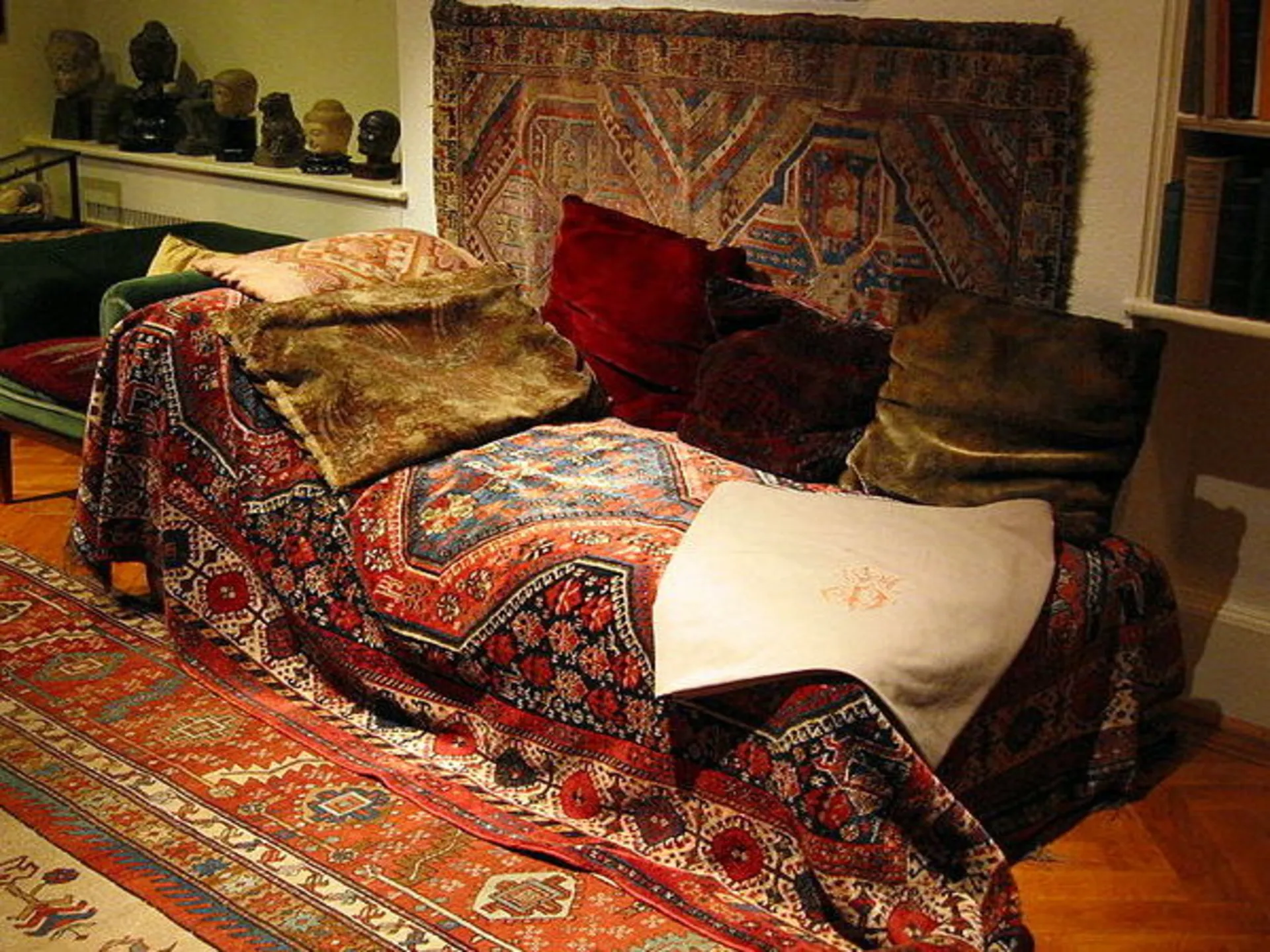
Freud wrote that he abandoned hypnotism, but retained the practice of having the patient lie on a sofa while he sat behind them, “seeing him, but not seen myself”.
The most famous piece of furniture in psychology is a leftover from hypnosis. Patients lay down to be hypnotised, and they kept lying down after the hypnosis stopped. Freud also seems simply to have disliked being stared at all day. He liked to watch his patients’ faces without them watching his.
The couch he used was a gift from a grateful patient, a Madame Benvenisti, around 1890. Beneath its rich Persian rug, a gift from his cousin Moritz, a dealer in antiques, it was a fairly plain piece of furniture, with a rough wooden frame piled with cushions. When Freud fled the Nazis in 1938, the couch went with him to London.
It’s still there, in the Freud Museum in Hampstead. A few years ago, the museum even commissioned artists to hire a police forensic team to analyse the dust on its rug, which was found to contain hair and cloth fibres with human DNA. Some of the traces might, in principle, belong to Freud’s famous patients.
What really happened to Anna O.
The neat story told in Studies on Hysteria, of a symptom traced to its source and then cured, didn’t survive later investigation.
Pappenheim’s condition had not truly improved when Breuer’s treatment ended. At his request, she was admitted to the Bellevue Sanatorium in Kreuzlingen, Switzerland. Over the following years, she was in and out of sanatoriums until 1887, battling recurring symptoms and an addiction to the morphine and chloral she had been prescribed for severe facial pain.
But the real Bertha Pappenheim went on to a life far larger than her case history. In 1904, she founded the League of Jewish Women (Jüdischer Frauenbund), the first national organisation to bring a feminist approach to the welfare of German Jewish women. She campaigned against trafficking and prostitution, ran a home for vulnerable girls, and wrote stories, poems and plays. In 1954, West Germany honoured her with a postage stamp, in a series called “Helpers of Humanity”.
She is said to have destroyed any documents about her youthful illness, so what she thought of “Anna O.” we’ll never know.
What became of Fanny Moser
Fanny Moser’s story didn’t end neatly either. After seven weeks of treatment, she returned home apparently improved. But her relationship with her daughters was badly strained, and she later blamed Freud, among others, for her daughter’s troubles.
She also kept searching for help elsewhere. One of the hypnotists she later turned to was the Swedish doctor Otto Wetterstrand, famous for keeping patients in prolonged hypnotic sleep. Her guest book shows that he came back to her estate in August 1896, apparently for yet another treatment. (You can read about him in The Doctor Who Put His Patients to Sleep for Weeks.)
Later historians have also looked more critically at Freud’s own account of her case. The historian Malcolm Macmillan argued that the main element of Freud’s therapy with Fanny Moser was altering her traumatic memories by direct suggestion under hypnosis. In his view, the emotional release that did happen seems to have come from Freud’s expectation that it should.
What Freud got right, and wrong
Freud’s decision to abandon hypnosis had huge consequences. As psychoanalysis spread through the twentieth century, hypnosis was pushed towards the margins of medicine for decades. As the hypnosis researcher Milton Kline put it, its position in the early 1900s was shaped to a great degree by psychoanalytic thinking.
Some of Freud’s concerns have stood the test of time. Memories that emerge under hypnosis can feel vivid and convincing without being accurate, a risk we explore in Hypnosis and Crime: Famous Cases and Controversies. And his realisation that the relationship between patient and therapist sits at the heart of change remains one of his most enduring insights.
But hypnosis didn’t disappear. It was carried forward by others, including a young American who would later become far more famous for it than Freud ever was: Milton Erickson. And modern research has shown that it can be genuinely useful for pain, anxiety and medical procedures. (For what modern science means by the hypnosis meaning, see our guide.)
The couch that remains
Visitors to the Freud Museum often linger by the couch, under its worn Persian rug and its heap of cushions. It’s a monument to psychoanalysis. It’s also a quiet reminder of where psychoanalysis came from: a young doctor who hypnotised his patients, and who learned some of his most important lessons from them.
One told him to stop asking questions and listen. One named the talking cure herself. And one, waking from a trance, threw her arms around his neck and showed him what had been happening all along.
Further reading
Primary sources
- Breuer J, Freud S. Studies on Hysteria. 1895. In Strachey J (ed.), The Standard Edition of the Complete Psychological Works of Sigmund Freud, Vol. 2. Hogarth Press, 1955.
- Freud S. An Autobiographical Study. 1925. Standard Edition, Vol. 20. Summary: https://www.oocities.org/mhrowell/autobiographical_study.html
Fanny Moser (Emmy von N.)
- Borch-Jacobsen M. “Freud’s Patients, A Serial: Fanny Moser (1848–1925).” Psychology Today, July 2012. https://www.psychologytoday.com/blog/freuds-patients-serial/201207/fanny-moser-1848-1925
- “Fanny Moser (baroness).” Wikipedia. https://en.wikipedia.org/wiki/Fanny_Moser_(baroness)
- Andersson O. “A supplement to Freud’s case history of ‘Frau Emmy v. N.’ in Studies on Hysteria 1895.” Scandinavian Psychoanalytic Review. 1979;2:5–16. Reprinted in Journal of European Psychoanalysis, No. 17 (2003). https://psychomedia.it/jep/number17/andersson.htm
- Macmillan MB. “Delboeuf and Janet as influences in Freud’s treatment of Emmy von N.” Journal of the History of the Behavioral Sciences. 1979;15(4):299–309.
Anna O. (Bertha Pappenheim)
- “Bertha Pappenheim.” Encyclopaedia Britannica. https://www.britannica.com/biography/Anna-O
- Guttmann MG. The Enigma of Anna O.: A Biography of Bertha Pappenheim. Moyer Bell, 2001.
- Ellenberger HF. “The story of ‘Anna O.’: a critical review with new data.” Journal of the History of the Behavioral Sciences. 1972;8(3):267–279.
- Borch-Jacobsen M. Remembering Anna O.: A Century of Mystification. Routledge, 1996.
The couch
- Freud Museum London. “Sigmund Freud’s Famous Psychoanalytic Couch.” https://www.freud.org.uk/?p=5708
- Freud Museum London. “Every Piece of Dust on Freud’s Couch.” https://www.freud.org.uk/?p=720
- “On the Couch.” London Review of Books blog, May 2013. https://www.lrb.co.uk/blog/2013/may/on-the-couch
Freud and hypnosis
- Kline MV. “Freud and hypnosis: a reevaluation.” International Journal of Clinical and Experimental Hypnosis. 1972;20(4):252–263.
Leave a Reply