
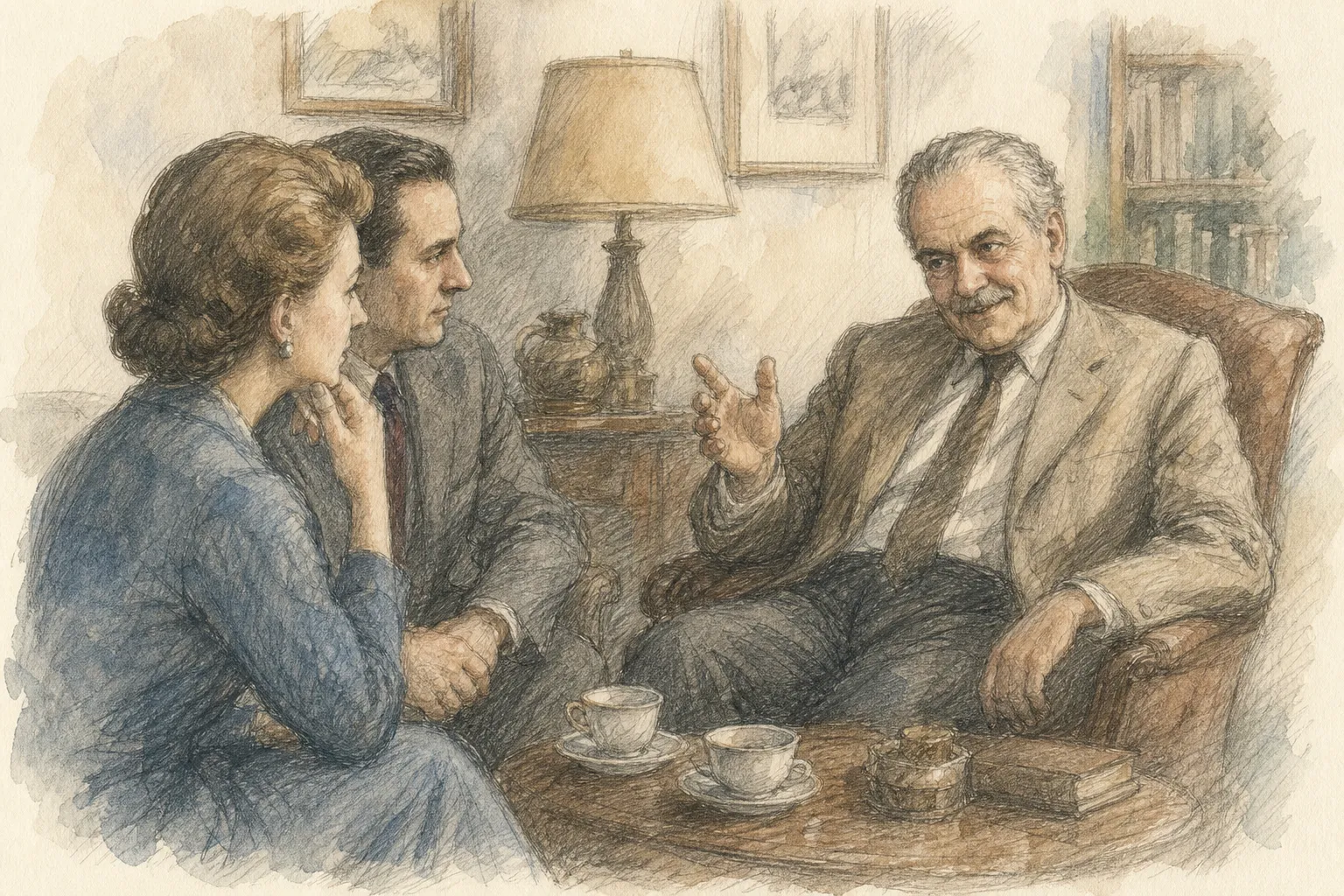
Arlene Wolberg didn’t go to Milton Erickson’s house expecting a session. It was sometime between 1945 and 1949, and her husband Lewis, a psychiatrist himself, was still shaking off an illness. The visit was social — coffee, conversation, the kind of low-key afternoon you have with an old colleague. Erickson started talking. And talking. And talking.
It wasn’t a lecture exactly, more a long, meandering, oddly rhythmic monologue that seemed to have no destination. Arlene felt her eyelids getting heavy. Her thoughts started to drift and loosen at the edges, the way they do right before sleep takes you under. And then, somewhere in that fog, a thought surfaced clear as a bell: he’s trying to hypnotize us.
She almost laughed out loud. Instead, she treated it like a private joke and a personal dare. If Erickson was going to slip a trance in under the cover of small talk, she wasn’t going to let it happen without a fight. She mentally shook herself, straightened her spine, and — in her own words — “snapped myself out of it.”
When Erickson eventually got up and left the room, Arlene looked over and caught something in his face: a gleam, a look of sly, private amusement, like a man who’d just pulled off a card trick and knew it. She turned to Lewis to see if he’d noticed anything odd about the visit. He had. In fact, he’d felt exactly what she’d felt — the same drowsy pull, the same monologue working on him like a slow tide.
They sat there comparing notes, half indignant and half delighted, piecing together that they’d both been quietly, casually, almost invisibly walked toward trance over coffee, with no couch, no pocket watch, no announcement that anything clinical was happening at all. That was the trick of it — Erickson hadn’t needed permission or ceremony. Just time, rhythm, and a captive, comfortable audience who thought they were simply visiting a friend.
“The old fox! The old devil! He was trying to hypnotize both of us.”
Source: Arlene W. Wolberg, ‘Unearthed from the Archives,’ Vol. 45 No. 1, p. 11