

On a windy afternoon in the 1920s, a young medical student named Milton Erickson was walking through Madison, Wisconsin, when a man came rushing around the corner of a building and slammed straight into him.
Before the man could apologise or complain, Erickson made a show of looking at his watch. Then, with perfect politeness, he told the man that it was exactly ten minutes of two. It was actually nearly four o’clock. Erickson walked on.
Half a block later, he glanced back. The man was still standing there, staring after him, completely bewildered.
Erickson never forgot that frozen moment. A stranger had been given something that made no sense at all, and for a few seconds his mind had simply stopped, waiting for an explanation that never came.

Erickson spent decades exploring what could be done in that gap. One of the things he built from it was the most famous rapid hypnotic induction in history: the handshake.
A three-thousand-year-old script
To understand why interrupting a handshake works, it helps to know how deeply the handshake is wired into us.
It’s very old. A carved throne base from the 9th century BC shows the Assyrian king Shalmaneser III clasping hands with a Babylonian king to seal an alliance.
One popular theory says the gesture began as a way of proving you weren’t holding a weapon.
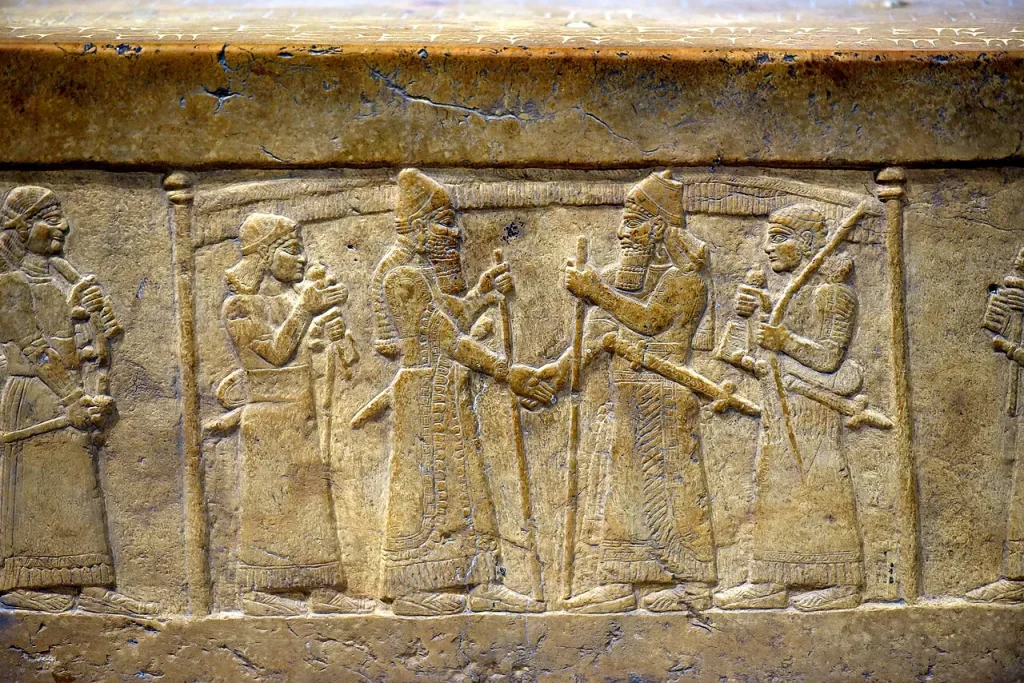

Whatever its origin, by adulthood most of us have shaken hands thousands of times.
In the 1970s, psychologists Roger Schank and Robert Abelson gave a name to routines like this: scripts. A script is a sequence of actions the brain runs on autopilot because it knows exactly what comes next. A handshake goes: see the hand, reach, grip, pump once or twice, release. You don’t decide each step. The script does it for you.
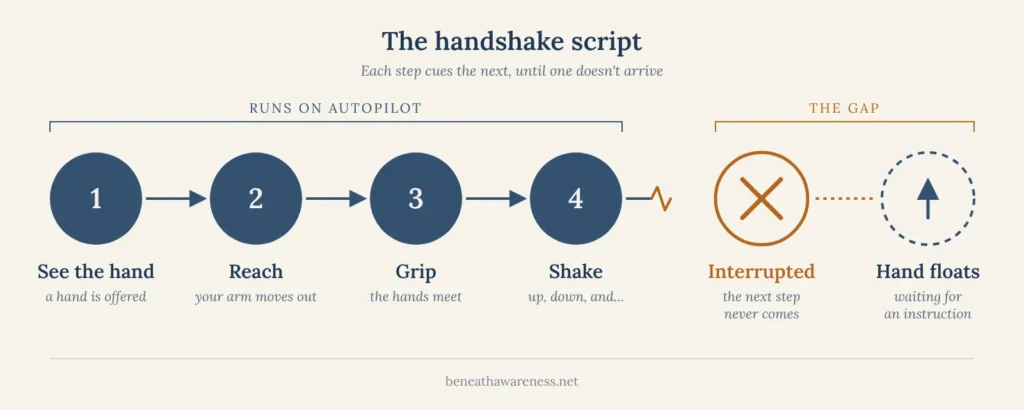
That is precisely what makes it vulnerable. When a script is interrupted halfway, the brain is suddenly left without its next instruction. Attention snaps to the present moment, and the mind does what the man on the windy street did: it pauses, searching for what happens now.
Psychologists call this reaction the orienting response, the brain’s built-in “what is that?” reflex. In that brief, unsettled pause, a calm, clear instruction is unusually likely to be followed.
How Erickson actually did it
Erickson’s version was remarkably gentle. He would begin an ordinary handshake. Then, instead of letting go in the usual way, he released his grip so slowly and unpredictably that the other person couldn’t tell when the shake was ending. He might:
- touch the hand lightly with his thumb, then a finger, then another, so the person’s attention chased each new sensation
- withdraw so gradually that his hand seemed to fade away rather than leave
- leave the person’s hand floating in mid-air, unsure whether it was still being held.
Often, it simply stayed there. Hypnotists call this catalepsy: a limb that holds its position effortlessly because nothing has told it to move. A hand left hanging by an unfinished handshake is waiting, in a very literal sense, for its next instruction.
Then Erickson would add a quiet suggestion, perhaps simply that the hand could stay right there while the eyes grew heavy. To the person on the other end, it often felt less like being told what to do and more like discovering what was already happening.
In 1979, Richard Bandler and John Grinder, the founders of neuro-linguistic programming, popularised Erickson’s handshake in their book Frogs into Princes, and it spread far beyond the clinic. Stage hypnotists later developed a much more abrupt version, in which they pull the volunteer’s arm suddenly forward and command “Sleep!” Same principle, very different style: one is a whisper in the gap, the other is a shove.
So what is actually happening?
This is where the handshake becomes more than a party trick. It sits right in the middle of one of psychology’s longest-running arguments: is hypnosis a special state of mind, or ordinary psychology in an unusual setting?
The hidden observer
In the 1970s, Stanford psychologist Ernest Hilgard was giving a classroom demonstration with a blind student. Under hypnosis, the student was told he would become completely deaf. When loud noises were made beside him, he showed no reaction at all.
Then, almost as an afterthought, Hilgard spoke to him quietly. Perhaps, he suggested, some part of the student could still hear his voice, and if so, that part could raise his index finger.
The finger rose.
When the student was brought out of hypnosis, he asked why his finger had lifted. He had felt it move, but had no idea why.
Hilgard called this the hidden observer. He came to believe that hypnosis splits consciousness, so that part of the mind goes on perceiving and processing while another part is unaware. His neodissociation theory, laid out in his 1977 book Divided Consciousness, would explain the handshake neatly: the interrupted script opens a door, and the mind divides along it.
The sceptics strike back
Not everyone was convinced. Canadian psychologist Nicholas Spanos ran a clever counter-experiment. He told hypnotised volunteers in advance either that their “hidden part” would be more aware of pain than their normal selves, or that it would be less aware. The hidden observers obligingly reported whichever one they had been told to expect.
For Spanos and fellow sociocognitive theorists such as Irving Kirsch, this was the giveaway. The hidden observer wasn’t uncovering a split mind. It was people responding to expectations, and doing their best to play the role they understood they were being given. Seen this way, the handshake works because the person knows hypnosis is coming, wants to cooperate, and reads the interruption as the moment it’s supposed to happen.
“It just happened by itself”
A newer theory tries to explain the most puzzling part of the experience: the feeling that things happen without your doing them.
British psychologist Zoltan Dienes and philosopher Josef Perner proposed cold control theory in the 2000s. The idea is that in hypnosis, you really do carry out the suggested action yourself. You simply don’t form the normal awareness that you intended it. Your arm floats because you lift it, but the thought “I am lifting it” never quite arrives, so it feels as if the arm rose on its own.
The theory made a testable prediction. If you could dampen the brain region that monitors our own intentions, people should become more hypnotisable. In 2013, Dienes and Stephen Hutton tried it. They used magnetic pulses to briefly disrupt a region of the brain linked to that kind of self-monitoring, the left dorsolateral prefrontal cortex. Volunteers’ responsiveness to hypnotic suggestions went up.
That gives a striking new reading of the handshake. The interruption may work partly by overloading the brain’s self-monitoring for a moment, just long enough for an action to happen without the usual “I did that” attached.
Do you even need the handshake?
Here’s the twist that most articles about rapid inductions leave out.
As far back as 1966, Ernest Hilgard and Charles Tart compared how responsive people were to suggestions with and without a formal hypnotic induction. The induction helped, but by less than you might expect. Many people responded well to suggestions with no induction at all. Later work by Irving Kirsch and Wendy Braffman in 1999 found much the same.
Then, in 2005, Benjamin Gandhi and David Oakley at University College London ran a deceptively simple experiment. They gave volunteers an identical relaxation exercise. The only difference was that for some volunteers it was called “hypnosis,” and for others it wasn’t. The people who heard the word “hypnosis” became noticeably more responsive to suggestions afterwards. The label alone made a difference.
This doesn’t make the handshake useless. It suggests that much of its power comes from what surrounds it: a person who knows hypnosis is about to happen, expects to respond, and is given a dramatic, unmistakable signal that this is the moment. The interrupted handshake is that signal, delivered through the body.
The words that follow
An induction only opens the door. What makes hypnosis useful is what’s said next. Erickson’s real skill wasn’t the handshake itself but the suggestions he wove into the pause it created, matched carefully to each person. That’s the subject of our article on hypnotic language.
A note on touch
The handshake is unusual among inductions because it relies on physical contact and surprise. That makes consent essential in a way it isn’t for, say, a breathing exercise. Ethical practitioners explain the technique first, ask permission, and offer a non-contact alternative. This matters especially for anyone uncomfortable with touch, for cultural or religious reasons, or because of past trauma. A surprise is only a useful tool when the person has agreed to be surprised.
Learning it
The handshake looks simple in videos, and that’s exactly why it’s often learned badly. The movement takes minutes to copy, but the timing, the reading of the person in front of you, and knowing what to do once the hand is floating take far longer. If you’re asking how do I learn hypnosis, begin with the foundations before the rapid techniques.
And remember the man on the windy street in Madison. He wasn’t hypnotised. He was just confused for a few seconds by a polite young stranger with a watch. But in those seconds, Erickson saw how much a mind will accept when its script runs out. The handshake induction is simply that moment, made deliberate.
Further reading
- Erickson MH. “The confusion technique in hypnosis.” American Journal of Clinical Hypnosis. 1964;6(3):183–207. This is the source of the windy-street story.
- Schank RC, Abelson RP. Scripts, Plans, Goals and Understanding. Lawrence Erlbaum, 1977.
- Bandler R, Grinder J. Frogs into Princes: Neuro Linguistic Programming. Real People Press, 1979.
- Hilgard ER. Divided Consciousness: Multiple Controls in Human Thought and Action. Wiley, 1977.
- Spanos NP, Hewitt EC. “The hidden observer in hypnotic analgesia: discovery or experimental creation?” Journal of Personality and Social Psychology. 1980;39(6):1201–1214.
- Dienes Z, Perner J. “Executive control without conscious awareness: the cold control theory of hypnosis.” In: Jamieson GA (ed.), Hypnosis and Conscious States. Oxford University Press, 2007.
- Dienes Z, Hutton S. “Understanding hypnosis metacognitively: rTMS applied to left DLPFC increases hypnotic suggestibility.” Cortex. 2013;49(2):386–392.
- Hilgard ER, Tart CT. “Responsiveness to suggestions following waking and imagination instructions and following induction of hypnosis.” Journal of Abnormal Psychology. 1966;71(3):196–208.
- Braffman W, Kirsch I. “Imaginative suggestibility and hypnotizability: an empirical analysis.” Journal of Personality and Social Psychology. 1999;77(3):578–587.
- Gandhi B, Oakley DA. “Does ‘hypnosis’ by any other name smell as sweet? The efficacy of ‘hypnotic’ inductions depends on the label ‘hypnosis’.” Consciousness and Cognition. 2005;14(2):304–315.