
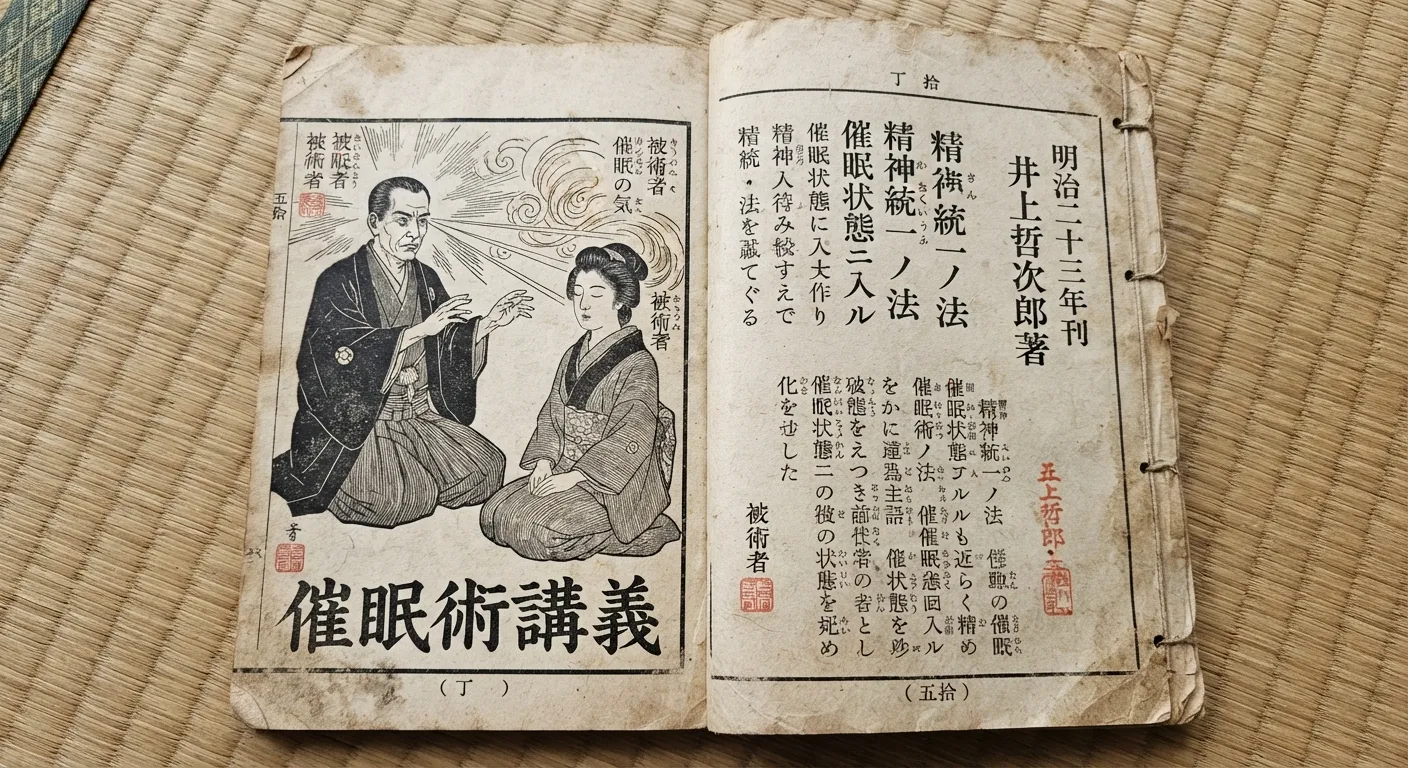
In 1908, the Japanese government did something no Western country had quite dared to do. It made practising hypnosis “without reason” a police offence.
Under Article 2.19 of the new Police Criminal Punishment Order, anyone caught hypnotising people without good cause could be detained for up to 30 days or fined up to 20 yen. Hypnosis had gone from a scientific novelty to something the state felt it had to control in barely twenty years. To understand why, you have to go back to a Japan in the middle of a revolution.
A craze arrives from the West
In the decades after 1868, Meiji Japan was racing to absorb Western science, medicine and technology. Hypnosis arrived with everything else. There doesn’t seem to have been a native Japanese word for it, so a new one was coined: saiminjutsu, roughly “the art of inducing sleep”.
It caught on fast. Through the 1890s and 1900s, bookshops filled with hypnosis manuals written for ordinary readers. Hypnosis schools opened, and correspondence courses promised to teach it by post. Its promises went far beyond medicine. Hypnosis, people were told, could sharpen memory, improve exam results, cure bad habits and unlock hidden mental powers.
Japan’s National Diet Library describes how these hopes created a genuine boom in expectations. For a society that prized learning and self-improvement, the idea that the mind could be trained to perform beyond its natural limits was irresistible.
The craze even crossed borders. Chinese students studying in Japan took hypnosis home with them. One revolutionary opposed to the ruling Manchu dynasty travelled to Japan in 1904 specifically to study it, and a Shanghai hypnotism society later claimed tens of thousands of graduates.
From cure to concern
As hypnosis spread, so did unease. Performers staged hypnosis shows. Unqualified practitioners set up as healers. Stories circulated of people exploited while hypnotised, and of minds supposedly unsettled by careless experiments. To a government anxious about public order, a technique that seemed to reach directly into people’s minds looked less like science and more like a risk.
The 1908 law was the result. Notably, it didn’t ban hypnosis altogether. Doctors and legitimate researchers could still use it. What it targeted was hypnosis “without reason”: the stage shows, the backroom healers, the amateurs experimenting on friends.
The clairvoyant and the professor
Two years later, a scandal showed just how blurred the line between science and the supernatural had become.
At Tokyo Imperial University, Japan’s most prestigious university, an assistant professor of psychology named Fukurai Tomokichi had written his doctoral thesis on the psychology of hypnotism. In 1910 he turned his attention to a young woman from Kumamoto named Mifune Chizuko, who was said to have the gift of senrigan: clairvoyance, literally “the eye that sees a thousand ri”.
According to the National Diet Library’s account, a relative had first tried to develop her powers through hypnosis. He then told her she could see through anything without being hypnotised at all, simply by breathing deeply and clearing her mind, and ordered her to practise every morning.
Fukurai and other scholars tested her. She reportedly identified objects and characters hidden from view, and the newspapers seized on the story. Soon other “clairvoyants” came forward, and the Senrigan affair became a national sensation, fiercely debated by scientists, journalists and the public.
Then the doubts set in. Critics accused the experiments of being poorly controlled, and suspicions of trickery mounted. The pressure on Chizuko was intense, and in early 1911 she took her own life. Fukurai went on to champion further psychic experiments, including claims of “thoughtography”, or projecting images onto photographic plates by thought, and was eventually forced out of the university.
What the story tells us
It’s tempting to see Meiji Japan’s hypnosis boom as simply credulous. But the same pattern appears in nearly every country that encountered hypnosis: excitement about a technique that seemed to unlock the mind, followed by exaggerated promises, then fear, then rules. In France it was a royal commission. In England, it was decades of medical scepticism. In Japan, it was the police.
The 1908 law captured something that’s still true: hypnosis itself wasn’t the danger. The danger lay in how people used it, and in what they believed it could do. That’s a debate hypnotherapists still have today, and it’s why the question of who should be allowed to practise hypnosis has never entirely gone away.
As our next story shows, it surfaced in Australia too, more than half a century later.
Further reading
- National Diet Library (Japan). “Chapter 1: Reading about the Senrigan Experiment.” https://ndl.go.jp/kaleido/e/entry/13/1.html
- “Hypnotism in China.” MCLC discussion list, May 2014. https://lists.osu.edu/pipermail/mclc/2014-May/003070.html
- Ichiyanagi Hirotaka. Saiminjutsu no Nihon kindai [Hypnotism and Japanese Modernity]. Seikyūsha, 1997.