

For more than two centuries, people have been trying to catch hypnosis in the act: to prove it, debunk it, measure it, or explain it. Along the way they’ve blindfolded volunteers in a garden, packed lecture halls in Paris, invented fake symptoms, handed people jars of acid, and slid hypnotised volunteers into brain scanners.
Here are the experiments that mattered most, and what each one revealed.
1. The magnetised apricot tree (1784)
The first great hypnosis experiment was designed to destroy it. A royal commission including Benjamin Franklin and Antoine Lavoisier tested Franz Mesmer’s claim that an invisible magnetic fluid could heal the sick. Their blindfolded volunteer collapsed beside an apricot tree that hadn’t been magnetised at all.
The commission concluded that the effects came from “imagination”. It meant this as a dismissal, but it was actually the first scientific clue to how hypnosis works. We tell the full story in our history of dental hypnosis.
2. The queen of the Salpêtrière (1880s)
A century later, hypnosis was the hottest show in Paris.
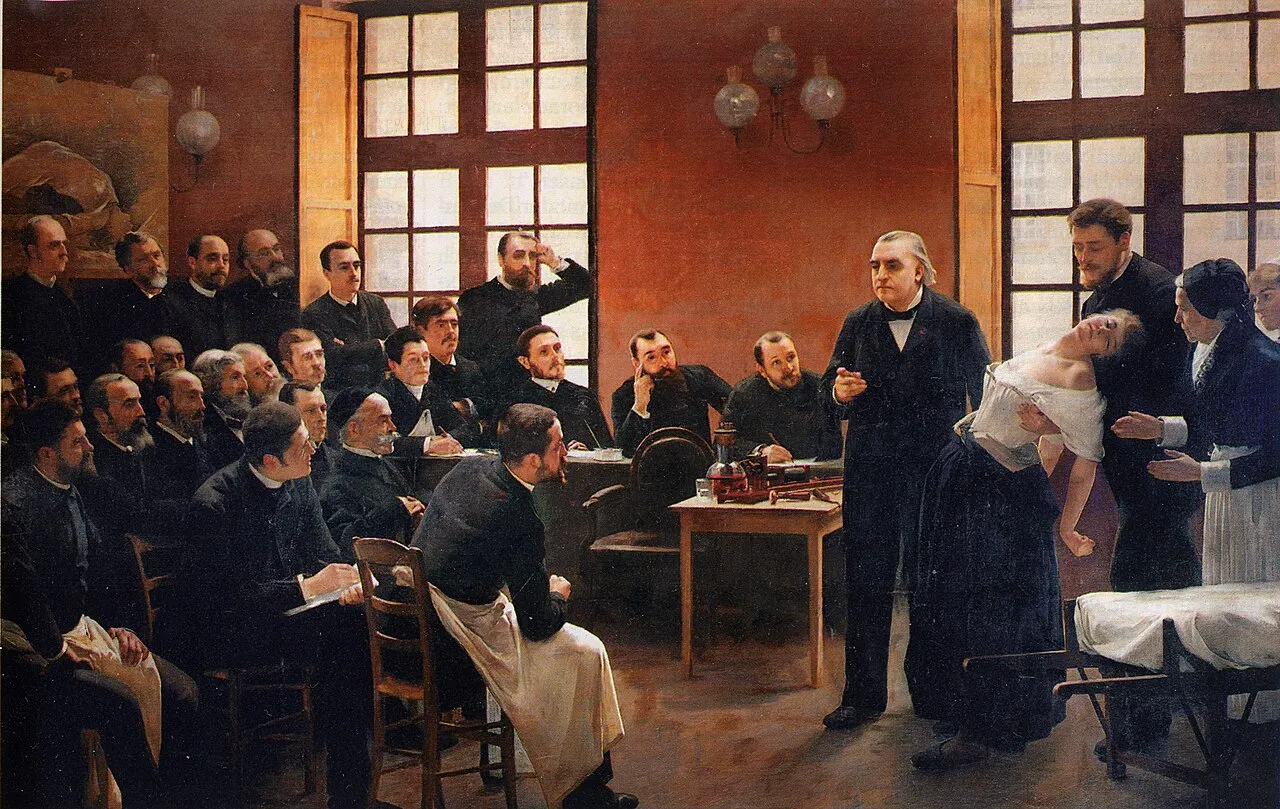
Every week at the Salpêtrière hospital, the celebrated neurologist Jean-Martin Charcot lectured to packed audiences of doctors, writers and fashionable onlookers. His star subject was a young woman named Blanche Wittmann. On cue, she would pass through what Charcot described as the three stages of “grand hypnotism”: limp lethargy, then rigid catalepsy, then sleepwalking. Then she would collapse into the arms of his assistant.
The scene was immortalised in André Brouillet’s 1887 painting A Clinical Lesson at the Salpêtrière (as shown), which shows Wittmann swooning into the arms of the young neurologist Joseph Babinski. One young doctor who studied under Charcot in those years was so struck that he kept a print of the painting in his consulting room for the rest of his life. His name was Sigmund Freud.
Charcot believed hypnosis was a symptom of nervous disease, something only the “hysterical” could experience, and that its stages were fixed and universal. He was wrong. His patients had lived on the wards for years, watching one another and learning, consciously or not, exactly what the great man expected to see. The stages appeared because they were expected.
3. The country doctor who worked for free (1880s)
Charcot’s great rival was a modest country doctor 300 kilometres away in Nancy.
Ambroise-Auguste Liébeault treated the town’s poor with an unusual offer: if you wanted medicine, you paid; if you let him hypnotise you, the treatment was free. Thousands accepted. Liébeault found that ordinary farmers, labourers and children could be hypnotised, not just hospital patients with nervous disorders.
When the respected medical professor Hippolyte Bernheim visited him, intending to expose a quack, he left a convert. Together they argued that hypnosis was simply a heightened response to suggestion, and that almost anyone could experience it. The “Nancy school” took on Charcot’s Paris and, over the following decades, won. Freud, who seemed to be everywhere, visited Nancy too.
4. Hypnosis goes into the laboratory (1920s–1930s)
The first person to study hypnosis with laboratory precision was the American psychologist Clark Hull. At the University of Wisconsin, and later at Yale, he ran careful controlled experiments, summarised in his 1933 book Hypnosis and Suggestibility.
Hull put the dramatic stage claims to the test. Could hypnotised people become super-strong, or remember things they otherwise couldn’t? Mostly, no. Hypnotised people didn’t outperform equally motivated people who weren’t hypnotised. What Hull found instead was that responsiveness to suggestion is real, measurable, and varies enormously from person to person.
Among the students in his early Wisconsin seminar was a young man who had recently recovered from polio: Milton Erickson.
5. The symptom that was invented (1959)
Then a psychiatrist named Martin Orne ran one of the cleverest experiments in the history of psychology.
He gave a lecture on hypnosis to a university class, and slipped in a detail he had made up entirely: that hypnotised people typically develop stiffness in their dominant hand. No such symptom exists.
Later, students from that class were hypnotised. Many of them developed exactly that symptom: a rigid dominant hand. Students who had attended other lectures, and never heard the invented detail, didn’t.
Orne had shown, in one elegant stroke, that people learn what hypnosis is supposed to look like and then experience it that way. It’s exactly what had happened on Charcot’s wards eighty years earlier. Orne called these hidden influences demand characteristics, and the term is now standard in every field of psychology that runs experiments on people.
6. The acid experiment (1965)
Can hypnosis make someone do something dangerous? Orne and his colleague Frederick Evans decided to find out.
Their hypnotised volunteers were asked to:
- pick up what looked like a venomous snake
- pull a coin out of a jar of fuming acid with their bare fingers
- throw the acid in a research assistant’s face.
Unknown to them, invisible glass protected them from the snake, and the acid had been switched for a harmless liquid.
Many of the hypnotised volunteers complied. But so did a second group who were not hypnotised at all, and had simply been asked to pretend to be hypnotised.
The real explanation wasn’t hypnosis. It was the laboratory. People went along with frightening instructions because they trusted that no respectable experimenter would really let them be hurt. The study is still one of the strongest answers to the fear that hypnosis can make people act against their will. It doesn’t. Context and trust do the heavy lifting. Real-world cases and claims are explored in our article on hypnosis crimes.
7. The hidden observer (1970s)
At Stanford, Ernest Hilgard found that a hypnotised student who had been told he was deaf could still lift a finger in response to a quiet question, as if part of his mind was listening all along. Hilgard concluded that hypnosis divides consciousness. His critics argued the “hidden part” was itself created by suggestion. The debate is still alive, and we explore it in depth in our article on the handshake induction.
8. Seeing colour that isn’t there (2000)
By the end of the twentieth century, researchers could finally look inside the hypnotised brain.
Psychologist Stephen Kosslyn and psychiatrist David Spiegel showed highly hypnotisable volunteers a pattern of grey shapes while scanning their brains, and suggested that they were looking at bright colours. The brain regions responsible for processing colour became active, as though the volunteers really were seeing colour. When they were shown a colourful pattern and told it was grey, activity in those regions dropped.
The volunteers weren’t just saying they saw colour. Their brains were processing the scene differently.
9. Voices that seem real (1998)
A team in Canada led by Henry Szechtman went one step further. They scanned highly hypnotisable people in three conditions:
- hearing a real recorded voice
- imagining the voice
- hearing it as a hypnotic hallucination, with no actual sound.
A region called the right anterior cingulate responded both to the real voice and to the hallucinated one, but not when the volunteers merely imagined it. To that part of the brain, a hypnotic voice was closer to a real sound than to imagination.
10. A trait that lasts a lifetime (1989)
Why does hypnosis work dramatically for some people and barely at all for others?
In the 1960s, Stanford researchers measured the hypnotisability of hundreds of students. Twenty-five years later, Hilgard’s team, with psychologists Carlo Piccione and Philip Zimbardo, tracked many of them down and tested them again. Their scores were remarkably similar, about as stable over a quarter of a century as IQ.
Twin studies had already suggested why. Identical twins are much more alike in hypnotisability than non-identical twins, so the trait appears to be partly inherited. How responsive you are to hypnosis is, to a large degree, part of who you are.
What two centuries of experiments add up to
Put these experiments together and a surprisingly clear picture emerges.
Hypnosis is real. It changes what the brain does with colour, sound and pain, not just what people say. But it is shaped profoundly by expectation, from Charcot’s wards to Orne’s invented hand: people tend to experience hypnosis the way they believe it works. It cannot override a person’s will. And people differ in their capacity for it in a way that is stable, measurable and partly inherited.
That’s why the hypnotist in the room matters so much, and why claims of hypnotic mind control have never survived the laboratory. For the darkest chapter of that story, see our article on mkultra hypnosis. For the memory research, including why hypnosis makes people more confident but not more accurate, see our article on hypnotic language. And for the basics of what science currently thinks hypnosis is, start with is hypnosis real.
Further reading
- Franklin B, Lavoisier A, et al. Report of the Commissioners Charged by the King with the Examination of Animal Magnetism. Paris, 1784.
- Harris JC. “A Clinical Lesson at the Salpêtrière.” Archives of General Psychiatry. 2005;62(5):470–472. This is a short history of the Brouillet painting and the people in it.
- Bernheim H. Suggestive Therapeutics: A Treatise on the Nature and Uses of Hypnotism. 1886; English translation 1889.
- Hull CL. Hypnosis and Suggestibility: An Experimental Approach. Appleton-Century, 1933.
- Orne MT. “The nature of hypnosis: artifact and essence.” Journal of Abnormal and Social Psychology. 1959;58(3):277–299.
- Orne MT, Evans FJ. “Social control in the psychological experiment: antisocial behavior and hypnosis.” Journal of Personality and Social Psychology. 1965;1(3):189–200.
- Hilgard ER. Divided Consciousness: Multiple Controls in Human Thought and Action. Wiley, 1977.
- Kosslyn SM, Thompson WL, Costantini-Ferrando MF, Alpert NM, Spiegel D. “Hypnotic visual illusion alters color processing in the brain.” American Journal of Psychiatry. 2000;157(8):1279–1284.
- Szechtman H, Woody E, Bowers KS, Nahmias C. “Where the imaginal appears real: a positron emission tomography study of auditory hallucinations.” Proceedings of the National Academy of Sciences. 1998;95(4):1956–1960.
- Piccione C, Hilgard ER, Zimbardo PG. “On the degree of stability of measured hypnotizability over a 25-year period.” Journal of Personality and Social Psychology. 1989;56(2):289–295.
- Morgan AH. “The heritability of hypnotic susceptibility in twins.” Journal of Abnormal Psychology. 1973;82(1):55–61.
Comments
5 responses to “Famous Hypnosis Experiments and What They Found”
[…] called these unspoken cues demand characteristics. (We tell the full story of these experiments in Famous Hypnosis Experiments and What They Found.) His work did not prove that hypnosis could never contribute to harm. It showed that what looks […]
[…] Martin Orne became the most influential hypnosis scientist of his generation, and his experiments did more than anyone’s to demolish the idea of hypnotic mind control. They are told in full in Famous Hypnosis Experiments and What They Found. […]
[…] most influential hypnosis researchers of the century. (You can read about his other experiments in Famous Hypnosis Experiments and What They Found.) His first experiment already contained a warning: going back in hypnosis doesn’t take you to […]
[…] That’s a remarkable description of a mind that keeps watch even while absorbed: selecting what matters, ignoring what doesn’t, and staying ready. It’s the same insight that later led Ernest Hilgard to his famous “hidden observer” experiments, and it undercuts one of the oldest myths about hypnosis: that a person in trance is helpless and unaware. (You can read about related research in Famous Hypnosis Experiments and What They Found.) […]
[…] kept a print of the famous painting of one of them for the rest of his life. (We tell that story in Famous Hypnosis Experiments and What They Found.) He also travelled to Nancy, to learn from Hippolyte Bernheim, Charcot’s great rival, who argued […]