
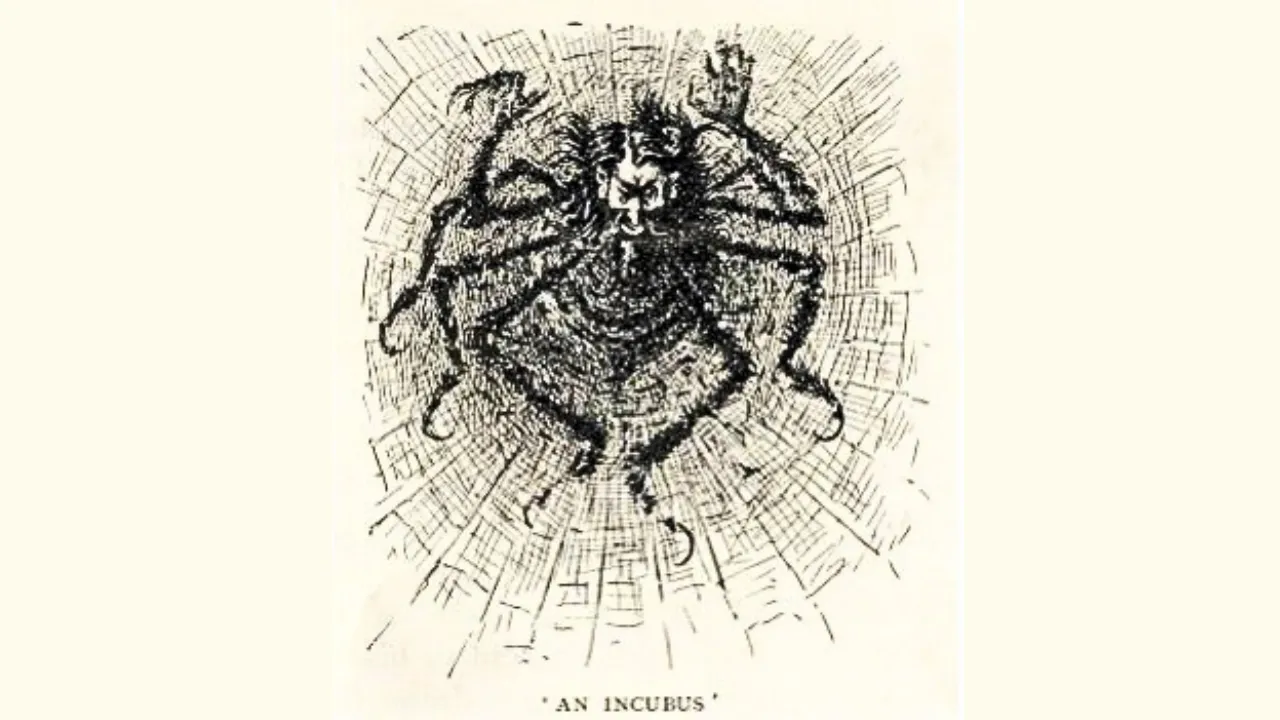

In 1894 George du Maurier gave the Victorian imagination its most durable villain. Svengali, the sinister musician of Trilby, takes a tone-deaf artist’s model and, by sheer force of his gaze, turns her into a soprano who enthrals the capitals of Europe. When he dies mid-performance, her voice dies with him. She had never been singing at all. He had been singing through her.
Du Maurier, who illustrated the novel himself, drew Svengali as a giant spider squatting at the centre of a web, and titled the picture “An Incubus”, after the demon of folklore said to press down on people as they slept. It remains one of the best-known images of a hypnotist in fiction.
The novel was a sensation, and its premise has never quite left us. The hypnotist as puppeteer, the subject as vessel, the crime committed by one body on behalf of another mind: these images recur in pulp fiction, Cold War thrillers, and courtroom defences alike. They rest on an idea that is as frightening as it is flattering to the hypnotist, namely that the will can be switched off from outside.
The historical record tells a stranger and more interesting story. Hypnosis has indeed been tangled up with crime for well over a century: as an alleged weapon, as an excuse, as an investigative tool, and as a source of courtroom testimony. Yet in almost every case, what looks at first like mind control turns out, on closer inspection, to be something more ordinary and more human. Trust, dependency, ideology, fear and the deeply malleable nature of memory do most of the work. The trance, where it appears at all, is rarely the whole explanation.
What the trance actually is
Stripped of stage lighting, hypnosis is a state of absorbed, narrowed attention in which a person becomes unusually responsive to suggestion. That is close to the definition the American Psychological Association’s hypnosis division settled on in 2014. The subject is not asleep, and how strongly people respond varies widely and stably from person to person. Crucially, nothing in that definition involves surrendering one’s will to another person. That distinction, between a tool that shapes experience and a key that unlocks obedience, is the hinge on which every case below turns.
Paris, 1890: the first hypnotic defence
The question of whether a hypnotist could command a crime was first argued in earnest in late nineteenth-century France, where two rival schools were fighting over what hypnosis even was. At the Salpêtrière in Paris, Jean-Martin Charcot treated it as a quasi-neurological condition found mainly in hysterical patients. In Nancy, Hippolyte Bernheim and the jurist Jules Liégeois argued that it was a matter of suggestion, something ordinary people could experience, and therefore something that might be abused.
Liégeois staged laboratory demonstrations in which subjects “stabbed” victims with paper knives and “poisoned” them with sugar water. He concluded that hypnotic crime was a real social danger. His critics replied that the subjects surely knew the knives were paper. That objection, that people behave differently when they sense the stakes are not real, would echo for the next hundred years.
The debate left the lecture hall in 1890 with the trial of Gabrielle Bompard. She and her lover, Michel Eyraud, had lured a Paris bailiff named Toussaint-Augustin Gouffé to an apartment, where he was strangled and his body packed into a trunk. Her defence, championed by the Nancy school, argued that Eyraud had hypnotised her into complicity. The jury was unpersuaded. Eyraud went to the guillotine, Bompard to prison for twenty years, and the court effectively ruled that a trance could not dissolve responsibility for a crime the accused had plainly helped to plan.
Copenhagen, 1951: the case that seemed to prove it
On 29 March 1951, a young man named Palle Hardrup walked into a branch of the Landmandsbanken in the Nørrebro district of Copenhagen, demanded money, and shot two employees dead. He was arrested almost immediately. What emerged over the following months made the case one of the most discussed in the history of forensic psychiatry.
Hardrup had met Bjørn Schouw Nielsen while both were imprisoned after the war for collaboration with the German occupiers. In their shared cell, Nielsen began hypnotising him, and over time built an elaborate inner world around the younger man. He presented himself as the voice of a guardian spirit, used the symbol “X” as a trigger, and wove in a mystical political mission involving the unification of the Nordic countries. Hardrup came to believe that robbing banks served that cause.
The psychiatrist Paul Reiter, who spent many sessions with Hardrup during the investigation, concluded that Nielsen had exercised hypnotic control over him. Nielsen was convicted and sentenced to life imprisonment, even though he had not been present at the shooting; Hardrup was confined to psychiatric care. Reiter’s later book on the case became a touchstone for anyone arguing that hypnosis could be weaponised.
Read closely, though, the Copenhagen case is less a demonstration of hypnotic power than a portrait of total psychological capture. Hardrup was isolated, dependent, ideologically primed and in thrall to a charismatic figure who controlled his sense of meaning. Hypnosis was one instrument among several, and quite possibly not the decisive one. Similar patterns of domination can be found in cults and abusive relationships where no trance is involved at all.
The laboratory tries to settle it
In 1939 the psychologist Loyd Rowland reported that hypnotised subjects, told to pick up a live rattlesnake behind what was in fact invisible glass, reached for it. Later researchers reported subjects willing to throw what they believed was fuming nitric acid into an assistant’s face. For a time it looked as though Liégeois had been vindicated.
The decisive correction came from Martin Orne, the University of Pennsylvania psychiatrist who would become the most influential figure in the scientific study of hypnosis. In a 1965 study with Frederick Evans, he added a control group who were not hypnotised at all, only asked to pretend, and they handled the snakes and threw the “acid” too. The explanation was not the trance but the setting: people assume a respectable scientist will not let anyone be hurt. Orne called these unspoken cues demand characteristics. (We tell the full story of these experiments in Famous Hypnosis Experiments and What They Found.) His work did not prove that hypnosis could never contribute to harm. It showed that what looks like obedience to a suggestion is often obedience to a situation.
Chowchilla, 1976: the license plate in the dark
If hypnosis could not reliably make people do things, perhaps it could help them remember. That hope reached its peak after one of the most audacious crimes in American history. In July 1976, three young men hijacked a school bus near Chowchilla, California, carrying twenty-six children and their driver, Frank Edward Ray. The captives were driven to a quarry in Livermore and sealed inside a moving van buried underground. Ray and the older children eventually dug their way out.
Ray had glimpsed the kidnappers’ vans but could not recall their plates. Under hypnosis, he reportedly produced a partial license number that investigators said helped them along. The kidnappers were caught, and the case became an advertisement for what came to be called forensic hypnosis. Through the late 1970s and early 1980s, police departments in the United States, and to a lesser extent elsewhere, sent officers on short courses and began hypnotising witnesses and victims as a matter of routine.
The trouble with a success story like Chowchilla is that it is selected for its success. Nobody publicises the hypnotic session that produced a confident, detailed and wrong plate number. A memory recovered under hypnosis can contain true fragments alongside invented ones, and without independent evidence there is no way to tell which is which. In Chowchilla, the plate could be checked. In many cases, nothing can.
Why memory betrays the hypnotist
The deeper problem lies not in hypnosis but in memory itself. We do not store experiences like footage to be replayed. Each act of remembering is an act of reconstruction, and even a single word can change it. In Elizabeth Loftus and John Palmer’s famous 1974 study, asking how fast cars “smashed” rather than “hit” each other led witnesses to recall broken glass that was never there.
Hypnosis amplifies exactly the features that make reconstruction risky. In 1983, Jane Dywan and Kenneth Bowers reported in Science that hypnotised subjects did recall more items from a set of pictures, but their new errors outnumbered their new correct answers. The same year, Jean-Roch Laurence and Campbell Perry showed that a suggestion given under hypnosis could become a “memory” that some subjects held onto even after learning it had been planted. (There is more on how words reshape memory in Hypnotic Language and Suggestion.)
Researchers now group the hazards under a few names:
- Confabulation: gaps filled with plausible detail, sincerely and without any intent to deceive.
- Contamination by leading questions: “What colour was the getaway car?” quietly installs a car.
- Source confusion: something imagined, suggested or read about is later felt as something seen.
- Memory hardening: confidence rises after hypnosis for accurate and inaccurate recollections alike.
The last is perhaps the most dangerous in a courtroom. Juries, quite reasonably, find confident witnesses persuasive. Hypnosis can manufacture confidence without manufacturing accuracy, and once a memory has been hardened, cross-examination struggles to soften it.
The courts take notice
By the early 1980s, judges were being asked to decide whether a witness whose memory had been “refreshed” under hypnosis could testify at all. Courts split into roughly three camps. Some admitted such testimony and left its weight to the jury. Some excluded it outright. A middle group admitted it only when strict procedures had been followed.
The middle path was shaped largely by Orne himself. In State v. Hurd (1981), the New Jersey Supreme Court adopted safeguards he had proposed: the hypnotist should be a trained professional independent of the police, told as little about the case as possible; the witness’s pre-hypnosis account should be documented; and every contact between them should be recorded. California went further in People v. Shirley (1982), largely barring testimony from previously hypnotised witnesses. In 1985 the American Medical Association’s Council on Scientific Affairs concluded that hypnotically refreshed recollections were less reliable than ordinary recall.
The United States Supreme Court added a twist in Rock v. Arkansas (1987). Vickie Rock, charged with shooting her husband, had recalled under hypnosis that the gun misfired, and a later examination found the weapon defective. The Court held that Arkansas’s blanket ban on her refreshed testimony violated her constitutional right to testify on her own behalf. The ruling did not endorse hypnotic memory; it simply refused to let a mechanical rule silence the accused. Other jurisdictions, including Britain and Australia, have tended toward guidelines and judicial caution rather than blanket rules.
Spies, interrogators and the Manchurian fantasy
If a hypnotist could not command a murder in a laboratory, perhaps a state could manage it with enough resources. The psychologist George Estabrooks thought so. In his 1943 book Hypnotism he speculated about hypnotically programmed couriers who would carry secrets they could not consciously reveal, and he later boasted of wartime work along those lines. His claims were never substantiated, but they fed a mood that would harden in the Cold War.
The CIA’s MKUltra programme of the 1950s and 1960s funded research into hypnosis alongside drugs and other methods of altering behaviour, and Richard Condon’s 1959 novel The Manchurian Candidate turned the fear into an enduring myth: the sleeper agent triggered by a playing card. The surviving record, much of it destroyed in 1973, suggests the agency found no reliable way to programme anyone. (The full story is in our article on MKUltra and hypnosis.)
Interrogation reveals the same limits from another angle. A relaxed, suggestible subject may talk more freely, but he is also more eager to please and more prone to agree with what the questioner seems to want. That makes hypnosis a poor instrument for extracting truth and a rather good one for producing confident error. Of all the dreams that have gathered around the trance, the truth serum is perhaps the most persistent and the least supported.
What the trance can and cannot do
Across a century of cases and experiments, a consistent picture emerges. Hypnosis is real: it can alter attention, perception, pain and imagination in measurable ways, and for some people the effects are profound. What it cannot do is replace one person’s will with another’s, or turn the mind into a recording that merely needs rewinding. Where crimes have been laid at its door, the more convincing culprits have been dependency, ideology, authority and coercion, forces that need no trance to operate.
Its value to investigators is correspondingly narrow. A hypnotic session might, now and then, surface a lead worth checking, as Chowchilla suggests. But anything it yields is a hypothesis rather than evidence, to be tested against documents, physical traces and independent accounts. Treated as proof, it risks hardening error into certainty and putting that certainty on the witness stand.
Svengali, in the end, was a projection of Victorian anxieties about influence, foreignness and female autonomy more than a portrait of any real hypnotist. Du Maurier drew him as a spider, and that is how we have pictured the criminal hypnotist ever since. The truth is less theatrical and, in its way, more unsettling. There is no spider at the centre of the web. We do not need to be entranced to be led. We only need to trust the wrong person, or to remember too eagerly what we have been invited to believe.
Further details
- du Maurier G. Trilby. Harper & Brothers, 1894. Public domain; full text and illustrations available on Project Gutenberg and the Internet Archive.
- Condon R. The Manchurian Candidate. McGraw-Hill, 1959.
- Estabrooks GH. Hypnotism. E.P. Dutton, 1943.
- Reiter PJ. Antisocial or Criminal Acts and Hypnosis: A Case Study. Munksgaard / Charles C. Thomas, 1958.
- Elkins GR, Barabasz AF, Council JR, Spiegel D. “Advancing research and practice: the revised APA Division 30 definition of hypnosis.” International Journal of Clinical and Experimental Hypnosis. 2015;63(1):1–9.
- Rowland LW. “Will hypnotized persons try to harm themselves or others?” Journal of Abnormal and Social Psychology. 1939;34(1):114–117.
- Orne MT, Evans FJ. “Social control in the psychological experiment: antisocial behavior and hypnosis.” Journal of Personality and Social Psychology. 1965;1(3):189–200. https://doi.org/10.1037/h0021654
- Loftus EF, Palmer JC. “Reconstruction of automobile destruction: an example of the interaction between language and memory.” Journal of Verbal Learning and Verbal Behavior. 1974;13(5):585–589. https://doi.org/10.1016/S0022-5371(74)80011-3
- Dywan J, Bowers K. “The use of hypnosis to enhance recall.” Science. 1983;222(4620):184–185.
- Laurence JR, Perry C. “Hypnotically created memory among highly hypnotizable subjects.” Science. 1983;222(4623):523–524. https://doi.org/10.1126/science.6623094
- State v. Hurd, 86 N.J. 525, 432 A.2d 86 (1981).
- People v. Shirley, 31 Cal.3d 18 (1982).
- Council on Scientific Affairs, American Medical Association. “Scientific status of refreshing recollection by the use of hypnosis.” JAMA. 1985;253(13):1918–1923.
- Rock v. Arkansas, 483 U.S. 44 (1987). https://supreme.justia.com/cases/federal/us/483/44/
- Home Office (UK). Circular 66/1988, The Use of Hypnosis in Criminal Investigations. 1988.
Comments
4 responses to “Hypnosis and Crime: Famous Cases and Controversies”
[…] The idea of the hypnotised courier had older roots. In 1943, the psychologist George Estabrooks speculated in his book Hypnotism about agents programmed to carry secrets they could not consciously reveal. His claims were never substantiated, but they helped shape the mood in which ARTICHOKE’s officers worked. (We look at Estabrooks and the wider history of hypnosis and crime in Hypnosis and Crime: Famous Cases and Controversies.) […]
[…] Ofshe concluded that a relaxation technique used early in the interrogation had amounted to inadvertent hypnosis, and that, combined with pressure from authority figures, it had produced false memories. Not everyone agreed. The judge in the case found the investigation imperfect but did not consider the confession tainted, and some argue that parts of the accusations had a degree of corroboration. But Ingram’s memories, often inconsistent with each other and unsupported by physical evidence, are now widely cited as a classic example of false memory. (There’s more on hypnosis, memory and the courts in Hypnosis and Crime: Famous Cases and Controversies.) […]
[…] bring back more memories, but also more errors, and greater confidence in both. (We look at that in Hypnosis and Crime: Famous Cases and Controversies.) Elizabeth’s trick is perfect for the name of an old neighbour. It’s not a way to settle what […]
[…] emerge under hypnosis can feel vivid and convincing without being accurate, a risk we explore in Hypnosis and Crime: Famous Cases and Controversies. And his realisation that the relationship between patient and therapist sits at the heart of […]