
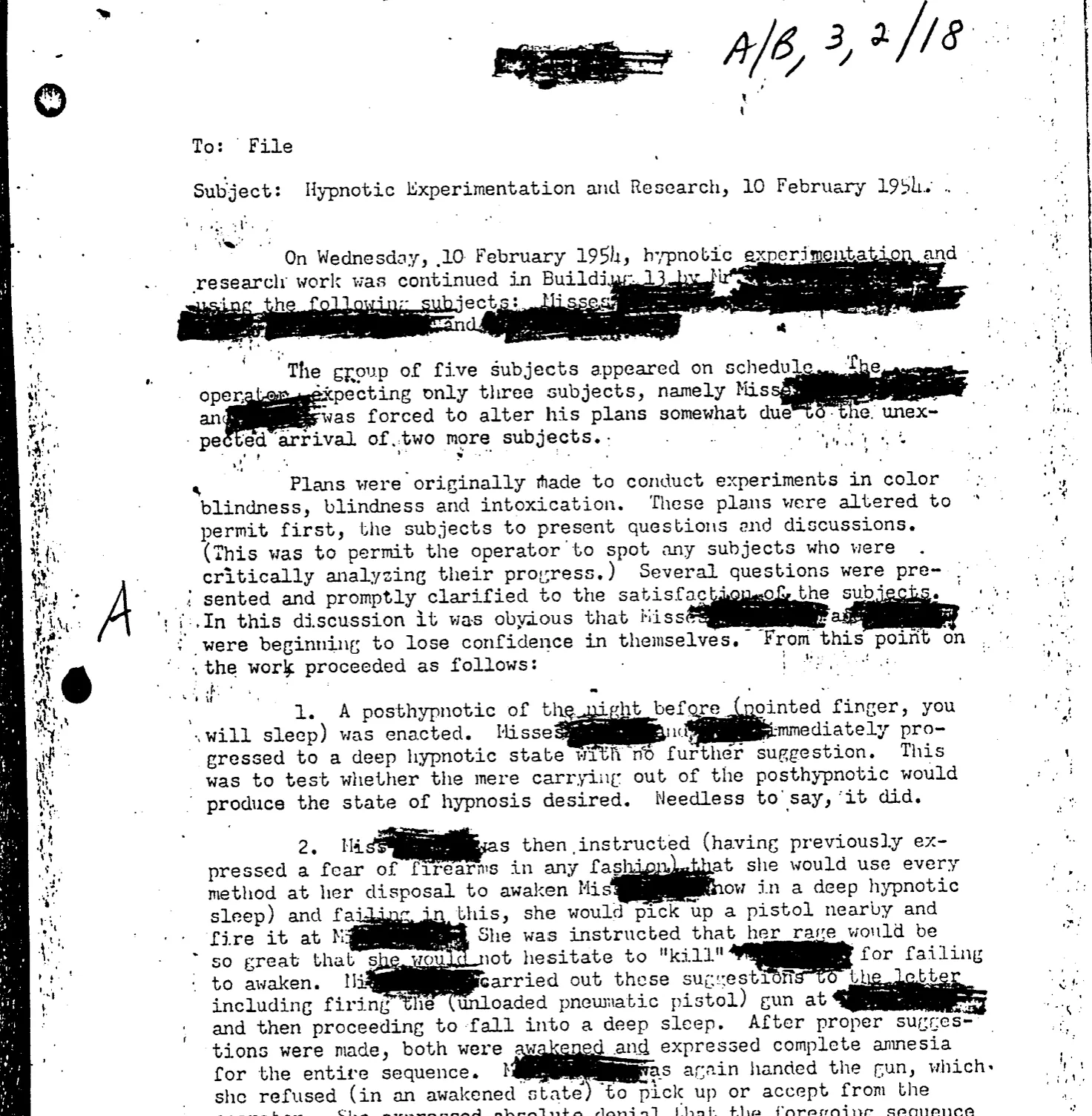
The memo
On Wednesday, 10 February 1954, a small team inside the CIA held what one of its files simply calls a session of hypnotic research. That day, according to the declassified memo, they had expected three subjects; five turned up, and the plan changed. The original intention had been to run experiments on colour blindness, blindness and intoxication.
What happened instead reads like a scene from a thriller. Two young women were hypnotised. One of them had expressed a fear of firearms. While her colleague lay in a deep hypnotic sleep, she was told to do everything she could to wake her, and if she failed, to pick up a pistol and fire it at her. She carried out the suggestions, firing what the memo describes as an unloaded pneumatic pistol, and then fell into a deep sleep herself. After further suggestions, both women were woken and said they remembered nothing at all.
The gun was empty. Nobody was hurt. But to the men running the experiment, it seemed to answer a question that had haunted the CIA since the start of the Cold War: could a person be made to kill on command, and then forget they had done it?
That question sat at the heart of one of the most notorious programmes in the history of American intelligence.
Why the CIA wanted to control minds
By the early 1950s, American officials were genuinely frightened. Communist states seemed able to make people say astonishing things. Show trials in Eastern Europe produced public confessions from prominent prisoners, and some American servicemen captured in Korea made propaganda statements denouncing their own country. In 1950 the journalist Edward Hunter popularised a new word to describe what he believed was happening: brainwashing.
Within the CIA, the fear became a research programme. If the Soviets and Chinese had a secret technique, the Americans needed it too, or at least needed to know how to resist it.
BLUEBIRD, ARTICHOKE, MKUltra
The work began in stages. An internal CIA review later recorded that an Office of Security team had experimented with drugs and hypnosis as early as 1949–50, under a project called BLUEBIRD. BLUEBIRD became ARTICHOKE, which the agency itself defined as its cryptonym for “special” interrogation methods, including drugs and chemicals, hypnosis, and “total isolation”.
The ambition was stated bluntly. One declassified ARTICHOKE memo, published by the National Security Archive, asks whether it was possible to gain control of an individual to the point where he would act against his will, and even against self-preservation.
Then, in 1953, came the programme that would give its name to the whole era. The proposal for MKUltra, a broader programme of research into the use of chemical and biological agents to alter human behaviour, was approved by CIA director Allen Dulles in April 1953. It was run by the agency’s chemist Sidney Gottlieb. According to the journalist Stephen Kinzer, whose biography of Gottlieb is the most detailed account of his life, MKUltra was the most sustained search in history for techniques of mind control.
The programme reached far beyond the CIA itself. According to the summary widely drawn from the congressional record, its activities ran through more than 80 institutions, including universities, hospitals, prisons and pharmaceutical companies, often through front organisations.
The hypnotic assassin
Hypnosis was never MKUltra’s only tool. LSD and other drugs took up far more of its money and attention. But the dream of a hypnotically programmed agent never went away.
In the same weeks as the empty-gun experiment, ARTICHOKE officers were thinking about a real-world version. A three-page memo, released in the late 1970s, records that an ARTICHOKE team visited an overseas location in January 1954 to evaluate a “hypothetical problem”: whether an individual of a particular nationality could be made to attempt an assassination involuntarily. The target country and nationality are blacked out. The memo’s conclusion was that, despite the elaborate setup, such an assassination “probably” could not be carried out.
When the memo became public, the CIA said none of the plans had been carried out and described the mind-control plans as purely hypothetical.
The idea of the hypnotised courier had older roots. In 1943, the psychologist George Estabrooks speculated in his book Hypnotism about agents programmed to carry secrets they could not consciously reveal. His claims were never substantiated, but they helped shape the mood in which ARTICHOKE’s officers worked. (We look at Estabrooks and the wider history of hypnosis and crime in Hypnosis and Crime: Famous Cases and Controversies.)
Erickson got there first
The CIA’s hopes ran against what one of hypnosis’s most famous figures had already published. In 1939, Milton Erickson reported a study in the journal Psychiatry testing whether hypnotised people could be made to commit antisocial acts. The paper, “An experimental investigation of the possible anti-social use of hypnosis”, appeared in volume 2 of Psychiatry, pages 391–414. His subjects refused or found ways around suggestions they found objectionable.
The research world was split. As Martin Orne later summarised it, Estabrooks, Rowland, Weitzenhoffer, Wells, Wolberg and Young had argued that hypnotised subjects could be compelled to carry out antisocial actions, while Erickson, the Australian psychiatrist Ainslie Meares, and Schilder and Kauders disagreed.
That disagreement would eventually be settled by a researcher the CIA itself was quietly paying.
The CIA’s money, and a Sydney laboratory
Martin Orne became the most influential hypnosis scientist of his generation, and his experiments did more than anyone’s to demolish the idea of hypnotic mind control. They are told in full in Famous Hypnosis Experiments and What They Found.
What few readers know is who helped fund him. In 1978, the Harvard Crimson reported that Orne’s Studies in Hypnosis Project had received approximately $30,000 from the CIA through the Human Ecology Fund, a foundation established by the CIA. The funding is listed as MKUltra Subproject 84.
The documents show the agency hoped for practical results. According to the CIA papers released to Harvard, officials were interested in hypnosis techniques that would produce “high motivation toward Agency goals” in their agents.
Orne’s own account was that he hadn’t known. He said the project received the money unwittingly, did not know the CIA’s reasons, and speculated that the research would have disappointed them if they had wanted to use hypnosis for mind control. The Crimson also reported that, unlike other MKUltra projects, the hypnosis work apparently did not deceive or harm its subjects, mostly students from Boston-area colleges.
That account has been challenged. One critical online essay claims that Orne later admitted he had known the true source of the funding all along. That claim comes from a strongly partisan source and should be read with caution. The documented record supports the funding itself, not what Orne knew.
There’s also an Australian chapter. Sydney’s student newspaper Honi Soit has reported that Orne’s research at the University of Sydney, conducted in 1960, was funded by the Human Ecology Fund, and that the University then had one of the few significant hypnosis laboratories in the world. Orne’s work there tested whether hypnosis could make people act against their will. The newspaper reports that his findings on the limits of hypnosis later informed CIA interrogation manuals, including the 1963 KUBARK manual.
The irony is hard to miss. The agency hoping to prove hypnosis could control minds was funding the scientist who did most to show it couldn’t.
The human cost
Hypnosis research mostly harmed no one. Much of the rest of MKUltra did. The programme’s victims deserve to be remembered as people, not as footnotes to a spy story.
Frank Olson. In November 1953, according to the Church Committee report, Sidney Gottlieb and his deputy served Olson, an Army scientist, and several colleagues a bottle of Cointreau laced with LSD. Nine days later, Olson died after falling from a New York hotel window. For more than twenty years, the CIA told the family only that he had died in the course of his official duties, without mentioning LSD.
The truth emerged in 1975. President Gerald Ford met the Olson family at the White House and formally apologised, and in a settlement authorised by Congress, the family received $750,000 in exchange for dropping their legal claims.
The family never accepted the official account that his death was a suicide brought on by the drug. A 1994 autopsy found a previously undisclosed injury to his temple, which the examining pathologist described as rankly and starkly suggestive of homicide. The Manhattan district attorney’s office opened a homicide investigation in 1996, and the designation of his death was later changed from “suicide” to “unknown”. The family filed another lawsuit in 2012, which a federal judge dismissed. More than seventy years on, what happened in that hotel room remains disputed.
The Montreal patients. The most harrowing chapter took place in Canada. Between 1957 and 1964, and possibly from as early as 1948, psychiatrist Donald Ewen Cameron conducted experiments at the Allan Memorial Institute in Montreal, a teaching hospital affiliated with McGill University. Cameron believed that a combination of electroshock treatments, drugs such as LSD, and “psychic driving”, the repeated playing of taped messages, could “de-pattern” the mind.
His patients were not volunteers in a spy programme. Many had come for ordinary psychiatric help. Velma Orlikow, for example, was admitted in 1957 for postpartum depression. After leaving the Institute, she had no memory of her husband and children.
Cameron, who died in 1967, received CIA money through the Society for the Investigation of Human Ecology, another CIA front. In 1988, Orlikow and eight others were awarded a total of US$750,000 by the CIA in an out-of-court settlement. In 1992, 77 survivors were compensated by the Canadian government. That payment was made without any admission of liability, and neither the CIA nor the Canadian government has apologised for the experiments they funded. The fight is not over. In late 2025, a class action was reported to be under way in Canada over the experiments.
Prisoners. MKUltra also tested drugs on people in federal prisons. One of them was the man who would become Boston’s most notorious gangster. According to Stephen Kinzer, James “Whitey” Bulger volunteered for what he was told was an experiment aimed at finding a cure for schizophrenia, while serving time in the Atlanta Penitentiary. In letters written decades later, Bulger said that since taking part he had been plagued by nightmares and gruesome hallucinations, and was unable to sleep for more than a few hours at a time. His account is his own, and some associates were sceptical. They assumed he would use the experiments to mount an insanity defence if he were ever tried.
Shredding the evidence
In early 1973, with Watergate gathering pace, the CIA’s director decided the record should disappear. According to the 1977 Senate hearing, the records of the programme’s activities were destroyed in January 1973 on the instructions of CIA director Richard Helms. The destruction was carried out by Sidney Gottlieb, working on Helms’s orders.
It nearly worked. When investigators came asking, the Senate was told, no one could be found who remembered the details: not the director who ordered the documents destroyed, not the official responsible for the programme, nor any of his associates.
How it came out
The first cracks appeared in the investigations that followed Watergate. In 1975, the Rockefeller Commission and the Senate’s Church Committee began exposing CIA abuses, including the drug-testing that led to Olson’s death.
Then, in 1977, a surprise. A freedom of information request uncovered a cache of about 20,000 documents relating to MKUltra, which led to Senate hearings. CIA director Stansfield Turner told senators that the newly found records were mostly financial files, the paperwork of payments that had survived because nobody thought to shred the accounts. The journalist John Marks used them to write The Search for the “Manchurian Candidate” (1979), still the essential history of the programme.
The joint Senate hearing, Project MKULTRA, the CIA’s Program of Research in Behavioral Modification, took place on 3 August 1977, chaired in part by Senator Edward Kennedy. Its transcript remains one of the main public sources for what happened.
Myths that grew from it
MKUltra was real, and that has made it fertile ground for stories that go well beyond the evidence.
- The programmed model. In 1976, the book The Control of Candy Jones claimed that the former fashion model had been hypnotically programmed by the CIA as a courier. The claims rested largely on hypnotic sessions conducted by her husband, a radio host. Given what research shows about memories produced under hypnosis, they have never been corroborated.
- The programmed assassin. The 1959 novel and 1962 film The Manchurian Candidate gave the world its enduring image of the hypnotised killer. The National Security Archive notes that the January 1954 memo shows the CIA did consider the idea of a hypnotised assassination, but the agency’s own documents concluded it probably could not be done.
- Continued secret work. Some researchers argue the work never really ended. The CIA has maintained that the programme was terminated, and the official record shows it was wound down over the 1960s and early 1970s. Because most files were destroyed, the full picture can’t be confirmed either way, and that gap is exactly where speculation thrives.
The line worth holding is simple. What’s documented is disturbing enough. What isn’t documented should be labelled as claim, not fact.
What MKUltra really proved
The CIA spent two decades and millions of dollars searching for a way to programme a human being. It harmed people who never consented. It destroyed most of its own records. And by every account in the surviving documents, it never found what it was looking for.
On hypnosis specifically, the agency’s own scientists kept running into the same wall that Erickson had described in 1939, and Orne demonstrated in the 1960s. People in hypnosis remain themselves. They respond to suggestion within limits set by their own values, and by their trust in the people around them.
Think back to the young woman with the empty gun in February 1954. She did pull the trigger. But she was in a room full of CIA officers, in a government building, taking part in an experiment she had every reason to believe was safe. Orne’s experiments later showed that people who are only pretending to be hypnotised will do the same. When she was handed the gun again, awake, she refused it.
What the memo really recorded wasn’t the power of hypnosis. It was the power of trust, and how easily that trust can be abused by the people we assume are looking after us. For more on whether hypnosis itself is real, and what it can and can’t do, see our guide to is hypnosis real, and for the wider story of the agency’s interest, our guide to cia hypnosis. Many of the hypnosis experiments mentioned here are told in full in our experiments article.
Further reading
Declassified documents and official records
- CIA. “Hypnotic Experimentation and Research, 10 February 1954.” Document 00428251. CIA Reading Room. https://www.cia.gov/readingroom/node/2078235
- CIA. “Memorandum for the Record: Project ARTICHOKE.” CIA Reading Room. https://cia.gov/readingroom/docs/PROJECT%20ARTICHOKE%5B12888369%5D.pdf
- National Security Archive. “Document Friday: Project ARTICHOKE, or the CIA Attempt to Create a Manchurian Candidate.” Unredacted, 23 April 2010. https://unredacted.com/2010/04/23/document-friday-project-artichoke-or-the-cia-attempt-to-create-a-manchurian-candidate
- United Press International, reproduced in CIA Reading Room. “CIA mind-control project included assassin-making.” CIA-RDP88-01315R000400410023-1. https://cia.gov/readingroom/print/760507
- United Press International / Science Trends, reproduced in CIA Reading Room. CIA-RDP88-01314R000300010018-3. https://www.cia.gov/readingroom/document/cia-rdp88-01314r000300010018-3
- United States Senate. Project MKULTRA, the CIA’s Program of Research in Behavioral Modification. Joint hearing before the Select Committee on Intelligence and the Subcommittee on Health and Scientific Research, 3 August 1977. CIA Reading Room 00163357. https://www.cia.gov/readingroom/document/00163357
- Assassination Records Review Board. Staff memorandum, “Subject: MKULTRA.” Via The Black Vault. https://documents3.theblackvault.com/documents/jfkfiles/NARA-Oct2017/ARRB/BSKWIROT/WP-DOCS/MKULTRA8.WPD.pdf
- US Senate Select Committee to Study Governmental Operations with Respect to Intelligence Activities (Church Committee). Final Report, Book I: Foreign and Military Intelligence. 1976.
- Commission on CIA Activities within the United States (Rockefeller Commission). Report to the President. June 1975.
Books
- Marks J. The Search for the “Manchurian Candidate”: The CIA and Mind Control. Times Books, 1979.
- Kinzer S. Poisoner in Chief: Sidney Gottlieb and the CIA Search for Mind Control. Henry Holt, 2019. (See also NPR’s interview with the author: https://www.npr.org/transcripts/758989641)
- Estabrooks GH. Hypnotism. E.P. Dutton, 1943.
- Hunter E. Brain-Washing in Red China. Vanguard Press, 1951.
- Collins A. In the Sleep Room: The Story of the CIA Brainwashing Experiments in Canada. Lester & Orpen Dennys, 1988.
- Bain D. The Control of Candy Jones. Playboy Press, 1976. (Cited as the source of the claims, not as evidence for them.)
- Condon R. The Manchurian Candidate. McGraw-Hill, 1959.
Hypnosis Research
- Erickson MH. “An experimental investigation of the possible anti-social use of hypnosis.” Psychiatry. 1939;2:391–414.
- Orne MT. “Antisocial behavior and hypnosis: problems of control and validation in empirical studies.” In Estabrooks GH (ed.), Hypnosis: Current Problems. Harper & Row, 1962. https://www.psych.upenn.edu/history/orne/orne1962estabrooksbc.html
- Orne MT, Evans FJ. “Social control in the psychological experiment: antisocial behavior and hypnosis.” Journal of Personality and Social Psychology. 1965;1(3):189–200. https://www.psych.upenn.edu/history/orne/orneetal1965jpsp189200.html
Orne and CIA funding
- “CIA Grants Funded Hypnosis Research.” The Harvard Crimson, 2 February 1978. https://dev.thecrimson.com/article/1978/2/2/cia-grants-funded-hypnosis-research-pthe/
- “The Week That Got Lost.” The Harvard Crimson, 11 February 1978. https://thecrimson.com/article/1978/2/11/the-week-that-got-lost-pmore
- Honi Soit (University of Sydney). Report on CIA-funded hypnosis research at the University of Sydney. https://honisoit.com/?p=47713
- “Martin Theodore Orne.” Wikipedia. https://en.wikipedia.org/wiki/Martin_Theodore_Orne
- For the dissenting claim about Orne’s knowledge: “False Memory Syndrome Foundation-as-CIA-Front.” Substack essay. https://childrenofjob.substack.com/p/false-memory-syndrome-foundation (a strongly partisan source, cited as an example of the claim)
Frank Olson
- “6 decades later, sons seek answers on death of Detrick scientist.” The Bulletin (via Baltimore Sun). https://bendbulletin.com/?p=2784
- “Nov. 28, 1953: LSD and the death of a CIA scientist.” ABA Journal. https://abajournal.com/magazine/article/nov-28-1953-lsd-and-the-death-of-a-cia-scientist
- “New Netflix Series Details CIA Mind Control Experiment.” CBS Baltimore. https://www.cbsnews.com/baltimore/news/netflix-frank-olson-wormwood
- Albarelli HP Jr. A Terrible Mistake: The Murder of Frank Olson and the CIA’s Secret Cold War Experiments. Trine Day, 2009. (Argues for homicide.)
The Montreal experiments
- “Montreal MKULTRA Experiments.” The Canadian Encyclopedia. https://thecanadianencyclopedia.ca/en/article/mkultra
- CBC News. Report on the Orlikow family and the 1992 compensation. https://www.cbc.ca/1.4449922
- “Stunning tale of brainwashing, the CIA and an unsuspecting Scots researcher.” The Scotsman. https://www.scotsman.com/arts-and-culture/stunning-tale-of-brainwashing-the-cia-and-an-unsuspecting-scots-researcher-2509823
- The Canadian Jewish News. Report on the class-action application. https://thecjn.ca/?p=182105
- “La class action contro gli esperimenti della CIA sugli esseri umani.” Il Post, 17 November 2025. https://www.ilpost.it/2025/11/17/canada-class-action-manipolazione-psicologica-mkultra/
Whitey Bulger
- “Whitey Bulger juror says she regrets murder conviction.” WBUR / Associated Press, 18 February 2020. https://www.wbur.org/news/2020/02/18/whitey-bulger-lsd-janet-uhlar
- NBC News / Associated Press, same report. https://www.nbcnews.com/news/us-news/whitey-bulger-juror-regrets-conviction-after-receiving-dozens-letters-crime-n1137871
Comments
One response to “MKUltra and Hypnosis: The CIA’s Search for a Programmable Mind”
[…] The CIA’s MKUltra programme of the 1950s and 1960s funded research into hypnosis alongside drugs and other methods of altering behaviour, and Richard Condon’s 1959 novel The Manchurian Candidate turned the fear into an enduring myth: the sleeper agent triggered by a playing card. The surviving record, much of it destroyed in 1973, suggests the agency found no reliable way to programme anyone. (The full story is in our article on MKUltra and hypnosis.) […]